Category: Smokers

Offset, vertical, electric, and pellet smoker guides and reviews.

  • Electric Smoker vs Charcoal Smoker: Flavor, Effort, and Cost Compared

    Electric Smoker vs Charcoal Smoker: Flavor, Effort, and Cost Compared

    The Smoking Yard is reader supported. When you buy through links on our site, we may earn an affiliate commission. As an Amazon Associate, we earn from qualifying purchases.

    Picking your first smoker usually comes down to one question: do you want convenience or do you want that deep, smoky, crusty barbecue you get from burning real fuel? The electric smoker vs charcoal debate is really a trade between time, money, and flavor, and neither side wins on every count.

    Electric smokers plug into a wall outlet, hold a set temperature on their own, and let you walk away. Charcoal smokers ask more of you, but they reward the effort with a darker bark, a stronger smoke ring, and more versatility. Below, we compare the two on flavor, effort, fuel cost, temperature control, cleanup, portability, and price, then suggest a few models on each side that are currently available.

    Quick Answer: If you want hands-off smoking with the least effort, get an electric smoker such as the Masterbuilt 30-Inch Digital Electric Smoker. If flavor and bark matter most, go charcoal: the Weber Smokey Mountain Cooker is the classic all-rounder, the Pit Barrel Cooker is the easiest charcoal option, and the Char-Griller AKORN Kamado gives you a smoker and a high-heat grill in one.

    Our Top Picks at a Glance

    ProductBest ForKey SpecsApprox. PriceLink
    Masterbuilt 30-Inch Digital Electric Smoker (MB20071117)Set-and-forget beginnersElectric, 710 square inches over 4 racks, 100°F to 275°F, side wood chip loaderAround $250Check price on Amazon
    Weber Smokey Mountain Cooker, 18-InchClassic charcoal flavor with long, stable cooksCharcoal water smoker, 481 square inches over 2 grates, water panAround $420Check price on Amazon
    Pit Barrel Cooker, 18.5-Inch ClassicEasiest charcoal smokingCharcoal drum smoker, hanging hooks and rods, grill grate, 30-gallon drumAround $430Check price on Amazon
    Char-Griller AKORN Kamado Charcoal GrillSmoking and searing on one cookerTriple-wall insulated steel kamado, 445 square inches total, 200°F to 700°FAround $400 list, often less on saleCheck price on Amazon

    Prices change often, so treat these as rough ranges and check the current price before you buy.

    How Electric and Charcoal Smokers Work

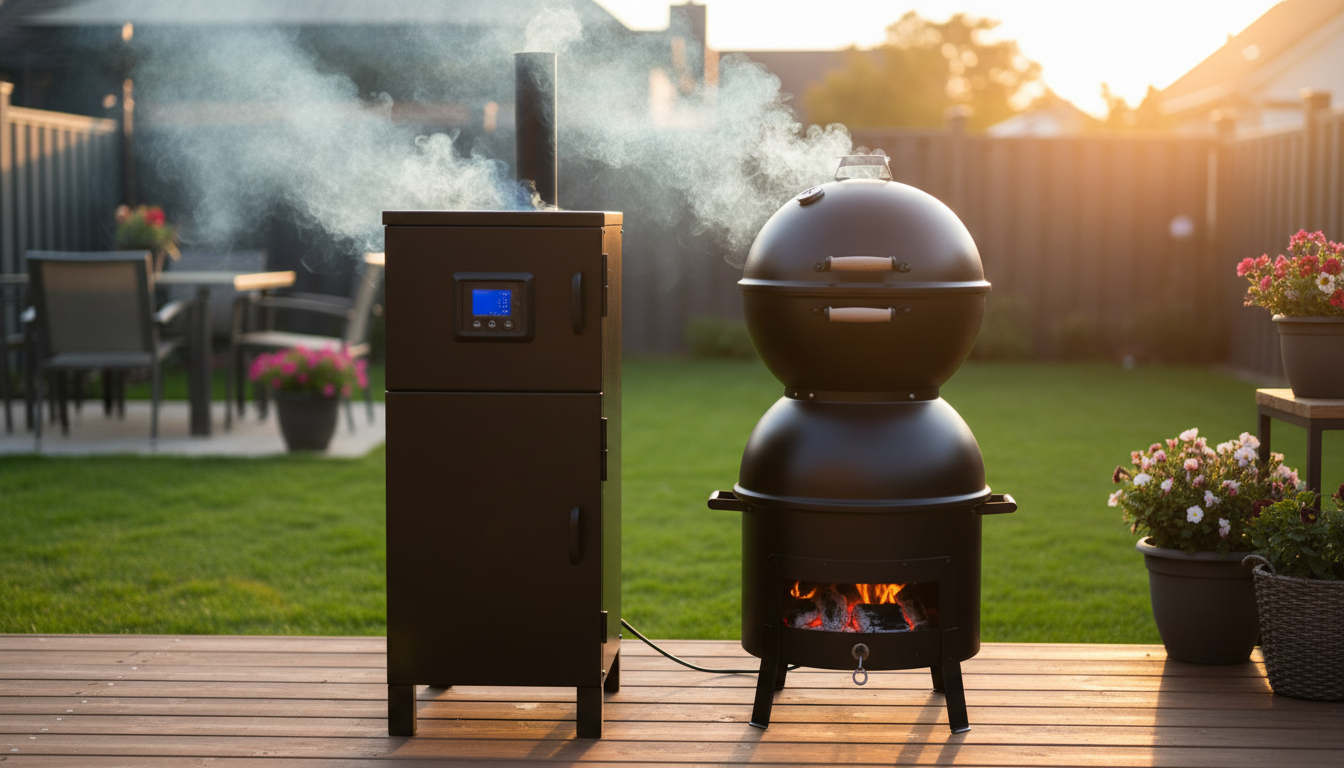
    An electric smoker uses a thermostat-controlled heating element, much like an oven, with a small tray of wood chips that smolders for smoke. A charcoal smoker burns lit coals, usually topped with hardwood chunks, and you control the heat with air vents (dampers). That live fire creates more smoke and combustion gases, which explains most of the differences below.

    Flavor and Bark

    This is where charcoal pulls ahead. Burning charcoal and wood chunks gives food a deeper, richer smoke flavor, and the dry heat of a live fire helps build a firm, dark bark on brisket and pork shoulder.

    Electric smokers produce a lighter smoke flavor. Their cabinets seal tightly and hold a lot of moisture, so owners often report a softer bark. The milder taste works well on fish, cheese, and poultry, but charcoal gets you closer to competition-style brisket. Owners who want more bark from an electric unit often finish the meat unwrapped or move it to a hot grill for the last stretch.

    Smoke Ring

    The pink smoke ring under the surface of smoked meat comes from gases released by burning fuel, mainly nitrogen dioxide and carbon monoxide, reacting with the myoglobin in meat. A charcoal fire gives off plenty of these gases, so charcoal smokers produce a clear, thick ring.

    Electric smokers smolder only a small amount of wood, so the ring is usually faint or missing. That’s a looks issue more than a taste issue: the smoke ring itself adds little flavor. If you cook for guests who judge barbecue by that pink band, though, charcoal makes a better first impression.

    Learning Curve

    Electric smokers are close to foolproof. You set a temperature on the digital panel, add chips, load the meat, and wait. A first-timer can turn out good pulled pork on day one.

    Charcoal takes practice. You need to learn how to light a fire, how many coals to use, how the vents respond, and how weather changes everything. Most beginners overshoot their target temperature on the first few cooks, because closing vents slows a fire gradually, not instantly. Some charcoal designs flatten the curve: the Pit Barrel Cooker uses one intake setting based on your altitude, and the Weber Smokey Mountain’s water pan acts as a heat buffer that forgives small mistakes.

    Babysitting Time

    With an electric smoker, your main job is reloading wood chips. Chip trays are small, so you’ll add chips every so often during the first few hours, which is when meat absorbs most of its smoke. Models with a side loader, like the Masterbuilt, let you add chips without opening the door. After that, you can run errands or sleep through an overnight cook.

    Charcoal smokers need more check-ins. Expect to watch the thermometer closely for the first hour while the fire settles, then make small vent tweaks every hour or two. On long cooks you may need to add fuel, and wind, rain, or cold weather can push temperatures around. Owners of well-built models like the Weber Smokey Mountain report long, steady stretches, but you still need to stay nearby.

    Fuel Costs

    Electric smoking is cheap to run. The Masterbuilt 30-Inch uses an 800-watt element, according to AmazingRibs’ review of the model. Even if the element ran nonstop for a 10-hour cook, that would use 8 kilowatt-hours (kWh). The US Energy Information Administration (EIA) projects the average residential electricity price at about 18.2 cents per kWh in 2026, so the worst case is roughly $1.50 in power. In practice the thermostat cycles the element on and off, so the real cost is often lower. Add a few dollars of wood chips per cook.

    Charcoal costs more per cook. A 16-pound bag of Kingsford Original briquettes usually sells for somewhere around $7 to $15 depending on the store and sales, and a long smoke can use a good portion of a bag, plus wood chunks. Kamados use less fuel because their insulated walls hold heat, and you can snuff the fire and reuse leftover lump charcoal next time. Over a season, electric is clearly cheaper to fuel.

    Temperature Stability and Range

    Electric smokers win on stability. A thermostat holds a set temperature without your input, which makes them ideal for low-temperature jobs like smoking cheese, jerky, or salmon. The catch is the ceiling: the Masterbuilt 30-Inch tops out at 275°F, according to the manufacturer. That’s fine for low and slow, but too cool for crisp poultry skin or hot and fast brisket. Cold weather can also slow electric units, since the element has to work harder to keep up.

    Charcoal smokers swing more, but they reach far higher temperatures. A kamado like the Char-Griller AKORN is rated from 200°F to 700°F, so it can smoke ribs in the afternoon and sear steaks at dinner. Vertical charcoal smokers like the Weber Smokey Mountain usually run in the classic 225°F to 300°F range with the water pan in, and hotter without it.

    Cleanup

    Electric smokers have no ash. You empty the chip tray and drip pan, wipe the racks, and you’re done.

    Charcoal means dealing with ash after every cook. Let it cool completely (it can stay hot for a long time) before you dump it into a metal container. Water smokers also have a greasy water pan to empty. Kamados with a pull-out ash pan, like the AKORN’s dump-style pan, make this much easier.

    Portability and Setup

    Electric smokers are fairly light (the Masterbuilt 30-Inch weighs about 42 pounds, based on retailer listings), but they need an outlet. That limits them at campsites and tailgates unless you bring a generator. Check the manual before using an extension cord, since manufacturers often have specific rules for them.

    Charcoal smokers go anywhere you can bring a bag of coals. The Weber Smokey Mountain (about 47 pounds) and the Pit Barrel Cooker break into a few pieces for travel. The AKORN Kamado is a different story: at nearly 90 pounds on a cart, it’s a backyard fixture, not a tailgate cooker.

    Price

    Entry-level electric smokers usually cost less up front. The Masterbuilt 30-Inch Digital lists at around $250 on the manufacturer’s site, and you can find basic analog electric units for less. Quality charcoal smokers like the Weber Smokey Mountain and Pit Barrel Cooker sit around $400 to $450, though cheaper charcoal options exist. Budget electric units also tend to have lighter construction. Weber, by contrast, backs the Smokey Mountain’s bowl, lid, and center section with a 10-year rust-through warranty, according to BBQGuys’ listing, which is far longer than most budget electric smokers offer.

    Electric vs Charcoal Smoker: Side-by-Side

    FactorElectric SmokerCharcoal Smoker
    FlavorMild, clean smokeDeeper, richer smoke
    BarkSofter (moist cabinet)Firmer and darker
    Smoke ringFaint or noneClear and thick
    Learning curveVery easyModerate; takes a few cooks
    BabysittingMinimal; refill chips early onRegular vent and fuel checks
    Fuel cost per long cookUsually under $2 in power plus chipsSeveral dollars in charcoal plus wood
    Temperature stabilityExcellentGood once you learn the vents
    Max temperatureOften around 275°FUp to about 700°F on a kamado
    CleanupEasy; no ashAsh disposal after every cook
    PortabilityNeeds an outletWorks anywhere
    Typical priceAround $250 for a good digital modelAround $400 for a quality smoker

    Which One Should You Choose?

    Choose an Electric Smoker If

    • You want to set a temperature and walk away for hours.
    • You’re brand new to smoking and want good results right away.
    • You plan to smoke cheese, fish, jerky, or other low-temperature foods.
    • You live where open fires or charcoal are restricted, such as some apartments and condos (check your building rules first).
    • You want the lowest upfront and running costs.

    Choose a Charcoal Smoker If

    • You care most about deep smoke flavor, firm bark, and a visible smoke ring.
    • You enjoy managing a fire and treating barbecue as a hobby.
    • You want to grill and sear as well as smoke.
    • You want to cook away from power outlets, at camp or on the road.
    • You want a smoker built to last many seasons.

    Best Electric Smoker Pick

    Masterbuilt 30-Inch Digital Electric Smoker (MB20071117)

    This is one of the most common first smokers in American backyards. Based on the manufacturer’s specs, it offers 710 square inches of space across four chrome-coated racks, a digital control panel with a 100°F to 275°F range, and a patented side wood chip loader so you can add chips without letting heat and smoke escape. Masterbuilt also sells a version with a glass window and legs for a little more.

    What we like: Simple digital controls, plenty of rack space for the price, and the side chip loader cuts down on door opening.

    Watch out for: The 275°F ceiling rules out crispy poultry skin, the lightweight build is typical of budget electric units, and Masterbuilt’s own site sometimes shows it out of stock, so check retailers too.

    Best for: Beginners and busy cooks who want reliable, hands-off smoking.

    Check price on Amazon

    Best Charcoal Smoker Picks

    Weber Smokey Mountain Cooker, 18-Inch

    The Weber Smokey Mountain (often called the WSM by owners) is a vertical charcoal water smoker that many pitmasters recommend as the best first charcoal smoker. Based on retailer specs, the 18-inch model has two 17.5-inch cooking grates for 481 square inches total, a porcelain-enameled water pan, and a built-in lid thermometer. A larger 22-inch version costs more and fits bigger cooks.

    What we like: Owners report very stable temperatures once the vents are dialed in, the water pan buffers temperature swings, and the 10-year rust-through warranty on the main body is generous.

    Watch out for: The access door is small, and the water pan adds a messy cleanup step.

    Best for: Cooks who want true charcoal flavor with a forgiving learning curve.

    Check price on Amazon

    Pit Barrel Cooker, 18.5-Inch Classic

    The Pit Barrel Cooker is a steel drum smoker built around simplicity. You hang meat from hooks inside the drum over a basket of charcoal, and drippings hit the coals to create flavorful smoke. According to the manufacturer, the Classic package includes eight stainless steel hooks, two hanging rods, a charcoal basket, a grill grate, a stand, and two rubs, and it fits up to eight racks of ribs or two turkeys of 13 to 16 pounds.

    What we like: Almost no vent management (you set one intake based on your altitude), a complete kit out of the box, and a big capacity for the footprint.

    Watch out for: It runs a bit hotter than classic low and slow, and fine temperature control is limited by design.

    Best for: Beginners who want charcoal flavor without learning to manage a fire.

    Check price on Amazon

    Char-Griller AKORN Kamado Charcoal Grill

    Kamados are egg-shaped cookers that hold heat well, and the AKORN offers that design at a fraction of the price of ceramic models. Based on Char-Griller’s specs, it has triple-walled insulated steel construction, cast iron cooking grates, 310 square inches of primary space (445 total with the warming rack), dual adjustable dampers, an easy-dump ash pan, and a 200°F to 700°F range.

    What we like: One cooker handles low and slow smoking, roasting, and high-heat searing, and the insulated body sips fuel compared with uninsulated smokers.

    Watch out for: Reviewers note that it heats up quickly and is hard to bring back down if you overshoot, so you need to sneak up on your target temperature. You’ll also want a heat deflector (Char-Griller sells one called the Smokin’ Stone) for indirect smoking.

    Best for: Cooks who want one charcoal cooker for both smoking and grilling.

    Check price on Amazon

    Buying Guide: What to Look For

    Cooking Space

    Think about the biggest cook you’ll do, like a whole brisket or several pork shoulders for a party. Square inches on a spec sheet can include small upper racks, so look at the size of each rack too.

    Temperature Range

    For pure low and slow, 225°F to 275°F covers it. If you want crisp chicken skin or the option to grill, choose a charcoal smoker or kamado that runs hotter.

    Build Quality and Warranty

    Thicker steel, good door seals, and long warranties usually mean a smoker that holds heat better and lasts longer. Read the warranty terms before you buy, especially on budget units.

    A Good Meat Thermometer

    Whichever smoker you choose, cook to internal temperature, not time. The US Department of Agriculture (USDA) lists safe minimums of 145°F with a 3-minute rest for whole cuts of beef and pork, 160°F for ground meats, and 165°F for all poultry. See the USDA safe minimum internal temperature chart for the full list. Brisket and pork shoulder are safe well before they’re tender; cooks take them much higher so the connective tissue breaks down.

    Frequently Asked Questions

    Does an electric smoker taste as good as charcoal?

    Electric smokers make tasty food, but the smoke flavor is lighter and the bark is softer. Most people can taste the difference side by side, especially on brisket. On fish, cheese, and poultry, the gap is smaller.

    Can you get a smoke ring in an electric smoker?

    Usually only a faint one. The ring forms when combustion gases react with meat, and electric smokers burn very little fuel. Some owners add more wood chips to deepen the smoke, but never put charcoal in an electric smoker unless the manual allows it.

    Is it cheaper to smoke with electric or charcoal?

    Electric is cheaper per cook. A long smoke on an 800-watt unit typically costs under $2 in electricity at average US rates, plus wood chips. Charcoal often runs several dollars per cook, depending on the cooker and the weather.

    Which is better for beginners, electric or charcoal?

    Electric is easier for a true beginner. If you want charcoal flavor without a steep learning curve, the Pit Barrel Cooker and Weber Smokey Mountain are both known as beginner-friendly charcoal options.

    Final Verdict

    Choose an electric smoker if you value convenience, steady temperatures, easy cleanup, and low running costs. The Masterbuilt 30-Inch Digital Electric Smoker is a simple, affordable way to start. Choose charcoal if flavor, bark, and versatility matter more than saving time. The Weber Smokey Mountain Cooker is the best all-around pick, the Pit Barrel Cooker is the easiest charcoal smoker to learn, and the Char-Griller AKORN Kamado is the one to get if you also want a high-heat grill.
  • How to Make Beef Jerky in a Smoker (Step-by-Step Recipe)

    How to Make Beef Jerky in a Smoker (Step-by-Step Recipe)

    The Smoking Yard is reader supported. When you buy through links on our site, we may earn an affiliate commission. As an Amazon Associate, we earn from qualifying purchases.

    Store-bought jerky costs a small fortune per bag, and most of it tastes more like sugar than beef. Making your own in a smoker fixes both problems. You pick the cut, you control the salt and spice, and you get real wood smoke in every bite.

    This recipe for beef jerky in a smoker walks you through every stage: choosing a lean cut, slicing it, building a savory marinade, deciding whether to use curing salt, running the smoker, and knowing exactly when the jerky is done. It also covers the food safety step that most home recipes skip, so your jerky is both tasty and safe.

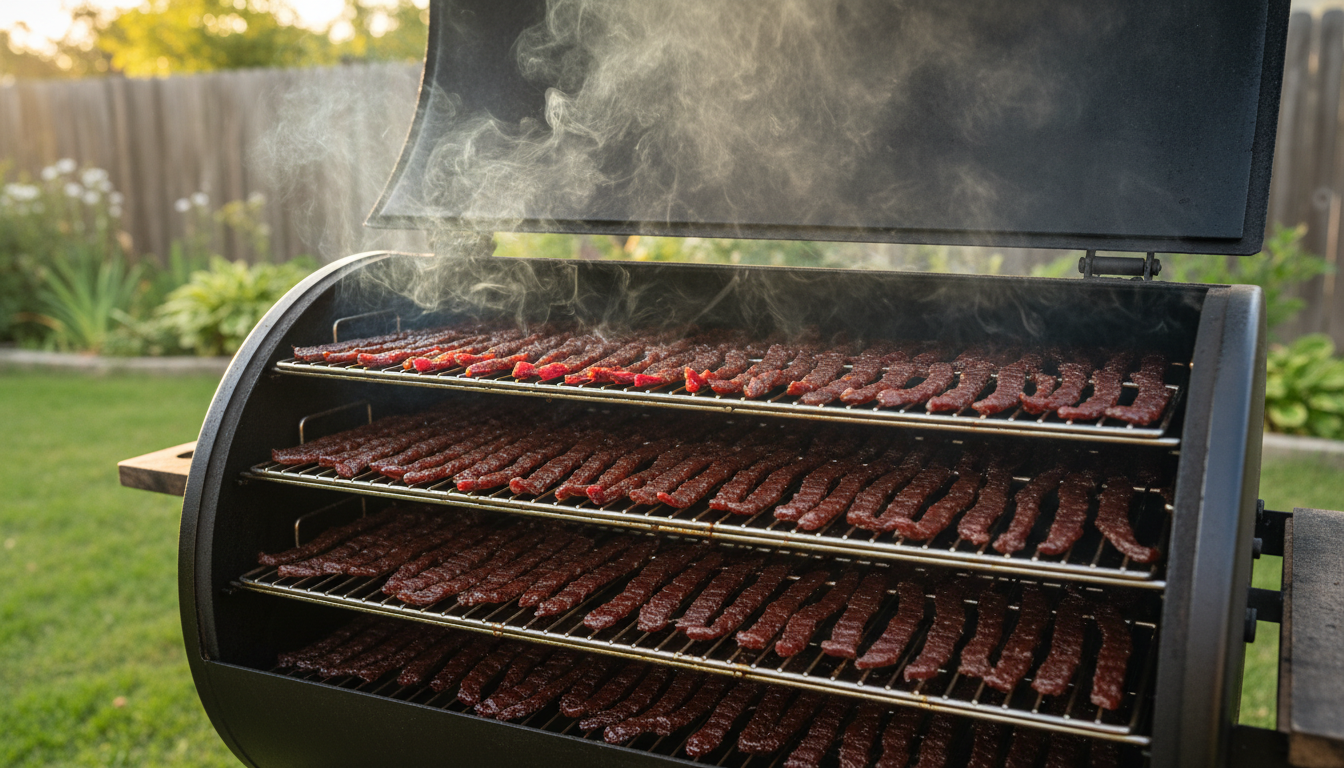
    Quick Answer: Slice 3 pounds of trimmed eye of round about 1/4 inch thick, marinate it in the refrigerator for 12 to 24 hours, then smoke it at 170°F to 180°F for roughly 4 to 6 hours. Confirm with an instant-read thermometer that the meat reaches 160°F, as the US Department of Agriculture (USDA) recommends. The jerky is done when a cooled strip bends and cracks without snapping in half. Store it airtight for 1 to 2 months, or freeze it for longer.

    Smoked Beef Jerky Recipe Card

    • Prep time: 30 minutes active, plus 1 to 2 hours of freezing for easier slicing
    • Marinating time: 12 to 24 hours in the refrigerator
    • Cook time: 4 to 6 hours in the smoker (thicker slices can take longer)
    • Smoker temperature: 170°F to 180°F
    • Yield: About 1 to 1 1/4 pounds of jerky from 3 pounds of raw beef
    • Wood: Hickory, oak, cherry, or apple
    • Difficulty: Easy, with patience

    Ingredients

    For the Beef

    • 3 pounds eye of round or top round, trimmed of all visible fat

    For the Marinade

    • 1/2 cup low-sodium soy sauce
    • 1/4 cup Worcestershire sauce
    • 1/4 cup water
    • 2 tablespoons packed brown sugar
    • 1 tablespoon apple cider vinegar
    • 2 teaspoons coarse ground black pepper
    • 1 1/2 teaspoons garlic powder
    • 1 teaspoon onion powder
    • 1 teaspoon smoked paprika
    • 1/2 teaspoon red pepper flakes (optional, for heat)
    • Optional cure: Prague Powder #1 at the manufacturer’s rate (for 3 pounds of meat, that works out to about 3/5 of a level teaspoon; see the curing section below)

    Equipment

    • A smoker that can hold a steady temperature between 170°F and 180°F (pellet grills, electric smokers, and well-tuned charcoal smokers all work)
    • A sharp slicing knife or an electric meat slicer
    • Jerky racks or wire cooling racks
    • An instant-read thermometer
    • A gallon zip-top bag or a nonreactive container for marinating
    • Paper towels
    • A vacuum sealer or airtight containers for storage

    Choosing the Right Cut

    Fat is the enemy of good jerky. It doesn’t dry out, it turns rancid much faster than lean muscle, and it shortens how long your jerky keeps. That’s why the best jerky cuts come from the round, the lean back leg of the steer.

    • Eye of round: The top choice for most home cooks. It’s very lean, inexpensive, and shaped like a uniform log, so every slice comes out the same size.
    • Top round: Just as lean and often sold as “London broil.” It’s wider, which gives you longer, broader strips.
    • Bottom round: Works fine but tends to be a little tougher and carries more connective tissue.

    Skip brisket, chuck, and ribeye for jerky. They taste great on a smoker, but their fat and marbling work against you here. Whatever cut you buy, trim off every bit of fat and silver skin you can see before slicing.

    With the Grain or Against the Grain?

    The direction you slice changes the texture of the finished jerky more than anything else in this recipe. Look closely at the raw meat and you’ll see long muscle fibers running in one direction. That’s the grain.

    • Slice against the grain (across the fibers) for tender jerky that tears easily and is easy to chew. Most people prefer this, especially for kids and snacking.
    • Slice with the grain (along the fibers) for the classic chewy, stringy jerky you pull apart with your teeth. It holds together well on hikes and hunting trips.

    Either way, aim for slices about 1/4 inch thick. Thinner slices dry faster but can turn brittle. Thicker slices take much longer and can stay soft in the center. Consistency matters more than the exact number: strips of the same thickness finish at the same time.

    Should You Use Curing Salt?

    Curing salt is optional for jerky that you heat properly and eat within a few weeks, but many smokers use it. Prague Powder #1 (also called pink curing salt #1 or Insta Cure #1) is a blend of regular salt and sodium nitrite. It gives jerky a rosy color and a cured, ham-like flavor, and it adds a layer of protection against bacteria during low-temperature smoking.

    Measure it carefully. Hoosier Hill Farm, a popular brand, lists its Prague Powder No. 1 as 6.25% sodium nitrite and gives a usage rate of 1 level teaspoon per 5 pounds of meat (or 1 ounce per 25 pounds). For this 3-pound batch, that means about 3/5 of a level teaspoon, or roughly 3.4 grams. The manufacturer recommends weighing both the meat and the cure on a kitchen scale, and that’s the most reliable way to get it right. Dissolve the cure completely in the marinade before adding the beef.

    A few rules apply to any brand. Follow the rate on your own package, because products differ. Never substitute Prague Powder #2, which is made for long, dry-cured sausages. Never use pink Himalayan salt as a “cure,” since it contains no nitrite. Keep curing salt labeled and out of reach of children. And remember that curing salt does not replace the heating step described below.

    How to Make Beef Jerky in a Smoker: Step by Step

    1. Trim and chill the beef. Trim all visible fat and silver skin. Wrap the roast and freeze it for 1 to 2 hours, until it’s firm but not frozen solid. Partly frozen meat is far easier to slice evenly.
    2. Slice the meat. Cut the chilled beef into 1/4-inch slices, against the grain for tender jerky or with the grain for chewy jerky. A meat slicer makes this fast and uniform, but a long, sharp knife works fine.
    3. Mix the marinade. Whisk the soy sauce, Worcestershire sauce, water, brown sugar, vinegar, pepper, garlic powder, onion powder, smoked paprika, and red pepper flakes together until the sugar dissolves. If you’re using Prague Powder #1, weigh it and stir it in until fully dissolved.
    4. Marinate in the refrigerator. Add the beef strips to a zip-top bag or covered container, pour in the marinade, press out the air, and massage it so every strip is coated. Refrigerate for 12 to 24 hours, turning the bag once or twice. Always marinate in the refrigerator, never on the counter.
    5. Drain and pat dry. Remove the strips and discard the used marinade; don’t reuse it or brush it back on. Lay the strips on paper towels and blot both sides. A dry surface takes on smoke better and speeds up drying.
    6. Preheat the smoker. Bring the smoker to 170°F to 180°F with your wood of choice. Hickory and oak give a bold, classic flavor; cherry and apple are milder and slightly sweet. If your smoker has a “smoke” or low setting that runs cooler than 160°F, don’t use it for this recipe.
    7. Arrange the strips. Lay the strips in a single layer on jerky racks or wire racks, leaving a little space between them so smoke and air can move around every piece. Don’t let strips overlap, or they’ll stay wet where they touch.
    8. Smoke and confirm 160°F. Place the racks in the smoker and close the lid. During the first part of the cook, check the thickest strips with an instant-read thermometer (folding a strip or stacking two gives the probe more to read). The meat itself needs to reach 160°F. If it isn’t getting there, raise the smoker temperature until it does, then bring it back down to finish drying.
    9. Keep drying. Hold the smoker at 170°F to 180°F and let the jerky dry for a total of about 4 to 6 hours. Rotate the racks every hour or so, since most smokers have hot spots. Blot away any fat beads that appear on the surface.
    10. Check for doneness. Start testing at around the 3 1/2 hour mark. Pull a strip, let it cool for 5 minutes, then bend it. Finished jerky bends and cracks on the surface but doesn’t snap in two. Remove strips as they finish; thin ones will be ready before thick ones.
    11. Cool and condition. Let the jerky cool completely on the racks. Then place it loosely in a zip-top bag for a day. If you see moisture beading inside the bag, the jerky needs more drying time.

    How to Tell When Smoked Beef Jerky Is Done

    Time and temperature give you a starting point, but humidity, slice thickness, and your smoker all change how long jerky takes. Use these checks instead of the clock:

    • The bend test: A cooled strip bends to about 90 degrees and shows small white cracks along the bend, but it doesn’t break. If it snaps cleanly, it’s overdried (still safe, just crunchy).
    • The tear test: Tear a strip in half. The inside should look dry and fibrous with no shiny, raw-looking, or wet center.
    • The feel: The surface feels dry and leathery, not tacky. A little surface oil is normal; moisture is not.

    Always judge a strip after it cools. Warm jerky feels softer than it really is, which leads a lot of beginners to overdry the whole batch.

    Food Safety Notes

    Jerky cooks at very low temperatures, and that’s exactly where harmful bacteria such as Salmonella and E. coli can survive if you’re careless. The USDA Food Safety and Inspection Service (FSIS) offers clear guidance in its Jerky and Food Safety fact sheet. The key points:

    • Heat beef to 160°F. The USDA recommends heating meat to 160°F (and poultry to 165°F) before dehydrating, by steaming or roasting, and checking it with a food thermometer. It notes that a dehydrator may not reach these temperatures on its own. In a smoker, verify with your thermometer that the strips themselves reach 160°F; if you can’t confirm it, follow the USDA’s method and steam or roast the marinated strips to 160°F before they go into the smoker.
    • Keep the drying temperature up. The USDA advises holding at least 130°F to 140°F throughout drying. Our 170°F to 180°F range gives you a comfortable margin.
    • Marinate cold and toss the marinade. Marinate in the refrigerator, and discard used marinade. Marinating does not make raw meat safe.
    • Keep everything clean. Wash hands, knives, cutting boards, and slicer parts in hot, soapy water after they touch raw meat.
    • Don’t rely on curing salt alone. Prague Powder #1 helps, but it doesn’t replace reaching 160°F.

    If you hunt and want to make venison jerky, read the full USDA page first; wild game has its own considerations.

    How to Store Homemade Jerky

    The USDA says home-dried jerky keeps about 1 to 2 months, compared with about 12 months for commercially packaged jerky. To get the most life out of your batch:

    • Let it cool completely and blot off surface oil before packing it.
    • Store it in airtight containers or vacuum-sealed bags, away from heat and light.
    • Refrigerate it for better quality over time, or freeze portions you won’t eat within a month or two.
    • Throw out any jerky that shows mold, smells off, or feels damp or slimy.

    Vacuum sealing is the best upgrade here. Removing the air slows the fats from going rancid and keeps the jerky from picking up moisture or fridge odors. Split the batch into snack-size packs so you only open what you’ll eat.

    Recommended Gear for Smoker Jerky

    You don’t need special equipment to make great jerky, but a few tools make the job faster and more consistent. We chose these based on manufacturer specs, retailer listings, and published owner reviews; we have not tested them ourselves. Prices are approximate and change often.

    ProductBest ForKey SpecsApprox. PriceLink
    LEM Jerky Rack and PanHolding strips in a single layer18 x 13 inch stainless steel rack, 1/2-inch grid, stacks 2 to 4 high; sold with 1 or 3 racksAround $18 to $47, depending on the setCheck price on Amazon
    Chefman Die-Cast Electric Deli SlicerEven 1/4-inch slices7.5-inch serrated stainless steel blade, 180-watt motor, adjustable thickness dialAround $40Check price on Amazon
    ThermoPro TP19H Instant-Read ThermometerConfirming 160°F3 to 4 second readings, ±0.9°F accuracy, 58°F to 572°F range, splash resistantAround $18 to $25Check price on Amazon
    Nesco VS-12 Deluxe Vacuum SealerLong-term storage130-watt double vacuum pump, dry, moist, and double seal settings, built-in bag cutterAround $100 to $150Check price on Amazon
    Hoosier Hill Farm Prague Powder No. 1Optional curing6.25% sodium nitrite; 1 level teaspoon per 5 pounds of meat per the manufacturerAround $13 for a 1-pound jarCheck price on Amazon

    Why These Tools Matter

    Jerky racks: LEM’s stainless steel rack has a tight 1/2-inch grid, so thin strips don’t sag through the grates, and the racks stack to fit more jerky into a small smoker. Any oven-safe wire cooling rack works in a pinch.

    Meat slicer: Owners report that budget slicers like the Chefman handle partly frozen lean beef well, and an adjustable thickness dial keeps every strip the same. It’s the single biggest help for consistent drying times. Clean it thoroughly after raw meat.

    Thermometer: An instant-read thermometer is the one tool we consider essential, because it’s the only way to confirm the 160°F food safety target. The ThermoPro TP19H carries an ingress protection rating of IP65, which means it resists dust and splashing water, and it costs far less than premium models.

    Vacuum sealer: The Nesco VS-12 offers a gentle vacuum setting and a pulse control, which helps keep sharp jerky edges from crushing or poking through the bag.

    Flavor Variations

    Once you’ve nailed the base recipe, the marinade is easy to change up. Keep the liquid amounts about the same and swap the seasonings:

    • Teriyaki: Replace the Worcestershire with pineapple juice and add 1 teaspoon of ground ginger.
    • Sweet and spicy: Add 1 tablespoon of sriracha and an extra tablespoon of brown sugar.
    • Cracked pepper: Cut the sugar in half and press extra coarse black pepper onto the strips right before smoking.
    • Chipotle lime: Add 1 teaspoon of chipotle powder and the juice of one lime.

    Frequently Asked Questions

    What temperature should I smoke beef jerky at?

    Aim for 170°F to 180°F. That’s warm enough to bring the meat to the USDA’s 160°F target and dry it steadily, but low enough that the strips dry instead of cooking into tough, crumbly pieces.

    How long does it take to smoke beef jerky?

    Usually 4 to 6 hours for 1/4-inch slices at 170°F to 180°F. Thicker slices, humid weather, or a crowded smoker can push it longer. Use the bend test, not the clock, to decide when it’s done.

    Do I have to use curing salt for smoked beef jerky?

    No. Jerky heated to 160°F, dried properly, and eaten within a couple of months is fine without it. Curing salt adds color, a cured flavor, and extra protection during low and slow smoking. If you use it, follow the manufacturer’s rate exactly.

    What’s the best wood for smoking jerky?

    Hickory and oak give a strong, traditional jerky flavor. Cherry and apple are milder and add a little sweetness. Mesquite works but can taste harsh over a long cook, so use it sparingly or blend it with a milder wood.

    Can I make jerky on a pellet grill?

    Yes. Pellet grills hold steady low temperatures well, which makes them a good fit for jerky. Just check that your model can hold 170°F to 180°F; some “smoke” settings run cooler than that, and you need the meat to reach 160°F.

    Why is my jerky tough?

    Tough jerky usually comes from slicing with the grain, cutting too thick, or overdrying. Slice against the grain for a tender bite, and start checking for doneness earlier on your next batch.

    Final Thoughts

    Smoked beef jerky comes down to a few simple habits: start with a lean cut like eye of round, slice it evenly, marinate it cold, and smoke it low while confirming the meat reaches 160°F. Judge doneness with the bend test, store it airtight, and eat it within a couple of months. After your first batch, you’ll have a reliable base recipe you can tweak with new woods and marinades every time you fire up the smoker.

  • Propane vs Electric Smoker: Pros, Cons, and Which to Choose

    Propane vs Electric Smoker: Pros, Cons, and Which to Choose

    The Smoking Yard is reader supported. When you buy through links on our site, we may earn an affiliate commission. As an Amazon Associate, we earn from qualifying purchases.

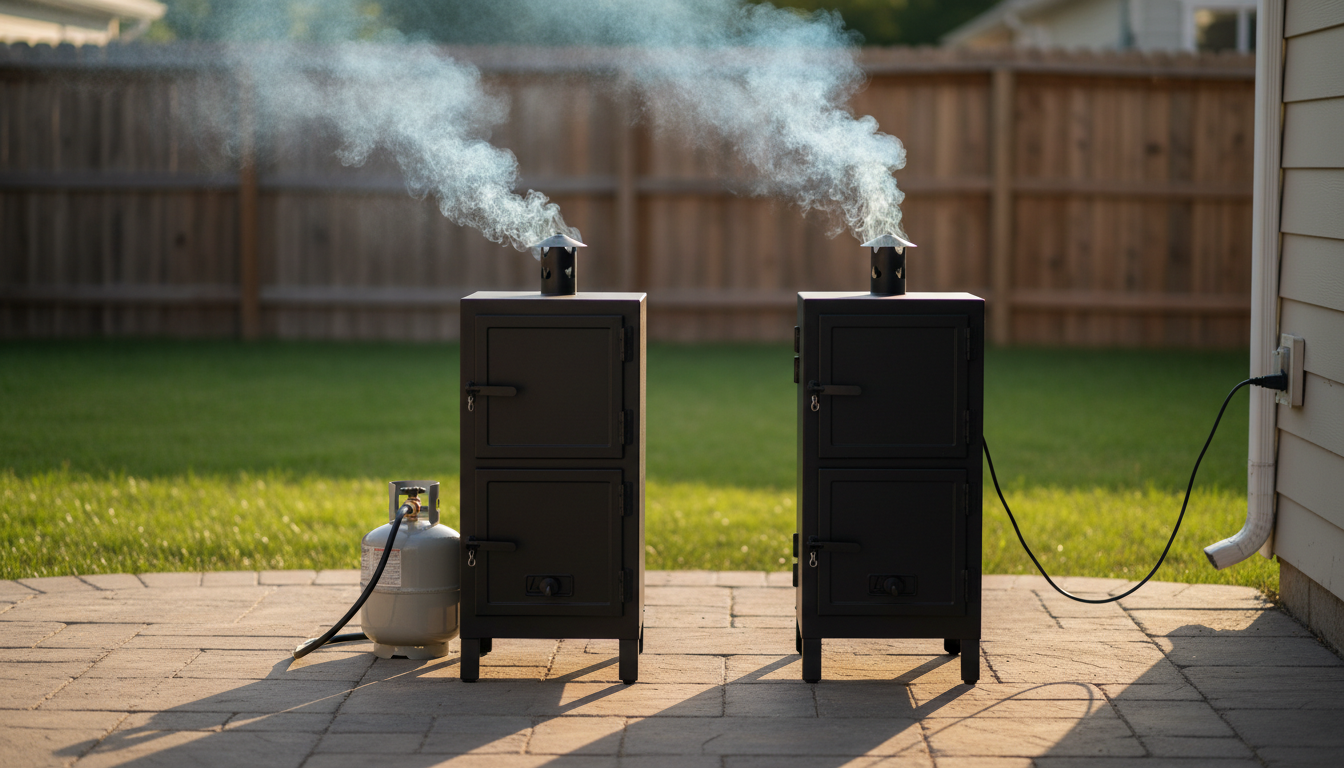
    Vertical smokers are the easiest way into low and slow barbecue. You set a temperature, add wood chips, and let the cabinet do the work. The big decision comes before you ever light it: do you want one that burns propane or one that plugs into the wall?

    The propane vs electric smoker debate comes down to a handful of tradeoffs: how precisely you can hold a temperature, how the smoker copes with cold and wind, how much smoke flavor ends up in the meat, where you can use it, and what each cook costs. This guide walks through each factor, does the fuel math with clearly labeled assumptions, and suggests a few current models on each side.

    Quick Answer: Choose an electric smoker if you want the most hands-off cooking, cook near an outdoor outlet, and care about low running costs; the Masterbuilt 30-Inch Digital Electric Smoker is the easy pick. Choose a propane smoker if you want more heat, better cold-weather performance, a stronger smoke ring, and the freedom to cook anywhere; the Masterbuilt 30-Inch Two Door Propane Smoker offers the best value, and the Masterbuilt 40-Inch ThermoTemp XL adds thermostat control and more space.

    Propane and Electric Smokers Compared

    ProductBest ForKey SpecsApprox. PriceLink
    Masterbuilt 30-Inch Two Door Propane Smoker (MPS 230S)Best value propane15,400 BTU burner, 730 sq in, 4 racksAround $250Check price on Amazon
    Masterbuilt 40-Inch ThermoTemp XL Propane SmokerSet and forget propaneThermostat dial, 960 sq in, 4 racksAround $400Check price on Amazon
    Char-Broil Vertical Gas Smoker (12701705)Propane with extra burner power16,500 BTU burner, about 595 sq in, 3 racksAround $350 to $475Check price on Amazon
    Masterbuilt 30-Inch Digital Electric Smoker (MB20071117)Best overall electric800 W element, 710 sq in, 100°F to 275°FAround $250Check price on Amazon
    Masterbuilt 40-Inch Digital Electric Smoker (MB20072918)Big batches, electric970 sq in, 4 racks, 100°F to 275°FAround $380Check price on Amazon
    Cuisinart COS-330 30-Inch Electric SmokerBudget electric with higher heat1,500 W element, 548 sq in, 100°F to 400°FAround $200 to $215Check price on Amazon
    Specs from manufacturer and retailer listings. Prices change often, so check the current price before you buy.

    We built this comparison from manufacturer specifications, retailer listings, and owner reports. We have not personally tested these smokers, and we note wherever a spec comes from a retailer rather than the brand.

    How Propane and Electric Smokers Work

    Both types use the same basic layout: a tall insulated cabinet, a heat source at the bottom, a wood chip tray above it, a water pan, and racks stacked on top. The difference is the heat source. A propane smoker burns liquefied petroleum (LP) gas from a standard 20-pound tank through a single burner, and you adjust the heat with a gas valve. An electric smoker uses a heating element, much like an oven, and a thermostat or digital controller switches it on and off to hold your set temperature.

    In both cases, the heat smolders wood chips to make smoke. Neither burns wood as its main fuel, so flavor will never match a stick burner offset, but both produce real smoked food with far less effort.

    Temperature Control

    Electric smokers win this round for most people. A digital electric smoker lets you punch in 225°F and walk away. The controller cycles the element to stay near that number, and many models include a meat probe. Owners report that the cabinet swings a few degrees above and below the setting as the element cycles, which is normal and harmless for barbecue.

    Most basic propane smokers use a manual valve, so you adjust the flame and watch a thermometer until the temperature settles. Wind, sun, and outside temperature all move that number, so expect to check in more often. Models with a thermostat valve, such as the Masterbuilt ThermoTemp line, close much of that gap by adjusting the gas flow for you.

    One catch for electric: many popular models top out at 275°F. That works for brisket, pork shoulder, and ribs, but crisp poultry skin usually needs 300°F or more. Propane smokers and some electric models, like the Cuisinart COS-330 (rated to 400°F), give you that extra headroom.

    Cold-Weather Performance

    Propane has a clear edge in winter. A 15,000 to 16,500 British thermal unit (BTU) burner puts out far more heat than an 800-watt element, which equals roughly 2,700 BTU per hour. When the air is freezing or the wind picks up, an electric smoker may run nonstop and still struggle to reach temperature. Owners in cold climates often add an insulated smoker blanket or move the unit out of the wind.

    Propane is not perfect in the cold either. Tank pressure drops as temperatures fall, so a nearly empty tank may not keep up on a frigid day, and strong gusts can blow out the flame on some models. Still, if you plan to smoke through a northern winter, propane is the safer bet.

    Smoke Flavor and Smoke Ring

    Both types get their smoke flavor from wood chips, so the type of wood and how cleanly it smolders matter more than the heat source. Even so, owners and barbecue writers commonly report that propane smokers produce a slightly deeper smoke flavor. A live flame heats the chip box more aggressively, which keeps chips smoldering and helps air move through the cabinet.

    The smoke ring, the pink band just under the bark, is where the difference shows most. That ring forms when gases from combustion, mainly nitrogen dioxide, react with the meat’s pigment. Burning propane creates those gases, while an electric element creates none, so electric smokers usually produce a thinner smoke ring or none at all. The ring is cosmetic and does not change taste, but if you care about presentation, propane has the advantage.

    Portability: No Outlet Needed

    A propane smoker runs anywhere you can bring a tank: a campsite, a tailgate, a hunting cabin, or the far corner of the yard. An electric smoker needs a nearby outdoor outlet, ideally a ground fault circuit interrupter (GFCI) outlet. Most manufacturers discourage extension cords; if you must use one, choose a short, heavy-gauge, outdoor-rated cord and follow your manual.

    Weight matters too. Both styles are tall cabinets that typically weigh between 40 and 70 pounds, so neither is truly portable, but propane at least frees you from the house.

    Running Costs: Propane Tank vs Kilowatt-Hours

    Electric smokers almost always cost less per cook. Here is the math for an 8-hour smoke at 225°F. Your results will vary with weather, insulation, how often you open the door, and local prices, so treat these as rough estimates.

    Electric Smoker Math

    • Assumption 1: an 800-watt (0.8 kilowatt) element, as used in the Masterbuilt 30-inch digital models.
    • Assumption 2: the element runs about 60% of the time once the smoker reaches temperature (our estimate, not a manufacturer figure).
    • Assumption 3: electricity costs 18.2 cents per kilowatt-hour (kWh), the US Energy Information Administration (EIA) forecast for the 2026 average residential price.

    0.8 kW × 8 hours × 0.60 = about 3.8 kWh. 3.8 kWh × $0.182 = about $0.70 per cook. Even if the element ran the entire time (6.4 kWh), the cost would be about $1.16.

    Propane Smoker Math

    • Assumption 1: a full 20-pound tank holds about 4.7 gallons of propane, and propane contains about 91,500 BTU per gallon, so a full tank holds roughly 430,000 BTU.
    • Assumption 2: at smoking temperatures, the burner averages about 10,000 BTU per hour (our estimate; burners in this class are rated at 15,000 to 16,500 BTU per hour on high).
    • Assumption 3: a 20-pound refill costs about $20. Tank exchanges typically cost more, around $20 to $30, and include less propane.

    10,000 BTU × 8 hours = 80,000 BTU, or about 19% of a tank. 19% × $20 = about $3.70 per cook. A cold, windy day with the burner on high could push that toward $5 or $6.

    Over 20 cooks a year, that works out to roughly $14 for electric and $74 for propane under these assumptions. Neither number will break the bank, but electric is clearly cheaper to run.

    Safety

    Both types are safe when you follow the manual, and both must stay outdoors. Never run either one in a garage, shed, or enclosed porch, because burning wood chips produce carbon monoxide whether the heat comes from gas or electricity. Keep at least the clearance your manual specifies from walls, fences, and overhangs.

    Propane adds gas handling. Check every connection with soapy water before the first cook and after each tank swap; bubbles mean a leak. Store tanks upright and outdoors, and close the valve when you finish. Electric adds water and wiring concerns. Plug into a GFCI outlet, keep the cord and controller dry, and cover the smoker when it is not in use.

    Food safety works the same on both. Cook to the safe minimum internal temperatures from the US Department of Agriculture (USDA) safe temperature chart: 165°F for poultry, 160°F for ground meats, and 145°F with a 3-minute rest for whole cuts of pork, beef, veal, and lamb. Use a reliable probe thermometer rather than the door gauge.

    Capacity

    Capacity depends on cabinet size, not fuel. In the Masterbuilt lineup, the 30-inch propane model lists 730 square inches and the 30-inch electric lists 710, nearly identical. Step up to 40 inches and you get 960 square inches (propane ThermoTemp XL) or 970 square inches (electric). As a rough guide, a 30-inch smoker handles a couple of pork shoulders or a few racks of ribs, while a 40-inch unit suits big family gatherings and full packer briskets.

    Price

    Upfront prices overlap almost completely. Entry-level 30-inch models on both sides list around $200 to $250, and 40-inch models with thermostats or extra features run around $380 to $450. Remember to budget for a propane tank (roughly $35 to $70 if you don’t already own one) on the gas side. Prices change often, so check current listings.

    Side-by-Side Summary

    FactorPropane SmokerElectric Smoker
    Temperature controlManual valve on most models; thermostat on someDigital set and forget
    Max temperatureTypically 350°F or moreOften 275°F; some reach 400°F
    Cold weatherStrong; more heat headroomWeaker; may need an insulated blanket
    Smoke ringVisible ring is commonThin or none
    PortabilityRuns anywhere with a tankNeeds an outdoor outlet
    Cost per 8-hour cook (estimate)About $3.70About $0.70
    Main safety concernGas leaks; check connectionsWater and wiring; use a GFCI outlet
    Typical priceAround $250 to $475Around $200 to $450

    Which Should You Choose?

    Choose a Propane Smoker If

    • You smoke in cold or windy weather.
    • You want to cook away from the house, at camp, or at a tailgate.
    • You care about a visible smoke ring and slightly bolder smoke.
    • You want temperatures above 275°F for poultry skin.

    Choose an Electric Smoker If

    • You want the most hands-off cooking possible, including overnight smokes.
    • You have a GFCI outlet near your patio.
    • You want the lowest cost per cook and no tank refills.
    • You mostly smoke in mild weather, or you can shelter the smoker from wind.

    Propane Smokers to Consider

    Masterbuilt 30-Inch Two Door Propane Smoker (MPS 230S)

    This is the classic starter propane smoker. According to Masterbuilt, it pairs a 15,400 BTU stainless steel burner with 730 square inches across four chrome-coated racks. The two-door design lets you add chips and water through the lower door without letting heat escape from the food chamber.

    What we like: Strong burner for the price, separate lower door, and solid capacity for a 30-inch cabinet.

    Watch out for: Manual temperature control means more babysitting, and owners report the door gauge can read off, so use a separate thermometer.

    Best for: First-time buyers who want propane at an entry-level price.

    Check price on Amazon

    Masterbuilt 40-Inch ThermoTemp XL Propane Smoker

    The ThermoTemp XL fixes propane’s biggest weakness. Masterbuilt says its thermostat dial adjusts the gas flow to hold your chosen temperature, and the cabinet offers 960 square inches across four racks with push-button ignition. It gives you much of an electric smoker’s convenience without the cord.

    What we like: Thermostat control, large capacity, and propane heat headroom for cold days.

    Watch out for: Masterbuilt’s own store showed it out of stock when we checked, so you may need to buy through a retailer. The maximum temperature listing on the product page is inconsistent (350°F vs 375°F).

    Best for: Cooks who want propane with near set and forget convenience.

    Check price on Amazon

    Char-Broil Vertical Gas Smoker (12701705)

    Char-Broil’s vertical propane cabinet uses a 16,500 BTU burner, the strongest of our picks. The manufacturer lists about 595 square inches across three adjustable grates plus a small warming rack, along with a water pan.

    What we like: Most burner power here, which helps in cold weather.

    Watch out for: Less cooking space than the Masterbuilt models, and prices vary widely between retailers.

    Best for: Cooks in colder climates who want extra heat.

    Check price on Amazon

    Electric Smokers to Consider

    Masterbuilt 30-Inch Digital Electric Smoker (MB20071117)

    This is one of the best-known electric smokers in the US. Masterbuilt lists 710 square inches across four racks, a digital panel that sets temperatures from 100°F to 275°F, and a side wood chip loader so you can add chips without opening the main door. Replacement parts listings show an 800-watt element.

    What we like: Simple digital controls, side chip loader, and a large owner community for tips and parts.

    Watch out for: The 275°F ceiling limits crispy poultry skin, and Masterbuilt’s own store showed it out of stock when we checked, though major retailers still list it.

    Best for: Beginners who want easy, hands-off smoking.

    Check price on Amazon

    Masterbuilt 40-Inch Digital Electric Smoker (MB20072918)

    The bigger sibling offers 970 square inches across four racks with the same 100°F to 275°F digital control. That extra space fits a full brisket or several pork shoulders at once.

    What we like: The largest capacity of our picks with the same easy controls.

    Watch out for: More cabinet to heat in cold weather, and the same 275°F limit.

    Best for: Families and anyone who cooks for a crowd.

    Check price on Amazon

    Cuisinart COS-330 30-Inch Electric Smoker

    Cuisinart takes a different approach with a 1,500-watt element and a dial that ranges from 100°F to 400°F, according to Home Depot’s listing. It has 548 square inches across three dishwasher-safe racks.

    What we like: A higher top temperature than most electric smokers and a stronger element for cooler days.

    Watch out for: Analog dial control is less precise than a digital panel, and capacity is the smallest here.

    Best for: Budget buyers who want an electric smoker that can also handle poultry.

    Check price on Amazon

    Frequently Asked Questions

    Does food taste better from a propane or electric smoker?

    Many owners report slightly stronger smoke flavor from propane, mostly because the flame keeps wood chips smoldering more steadily. The difference is modest, and your choice of wood and technique matters more.

    Why don’t electric smokers make a smoke ring?

    The smoke ring forms when combustion gases react with pigment in the meat. An electric element burns no fuel, so it produces far fewer of those gases. The ring is visual only and does not affect taste or doneness.

    How long does a 20-pound propane tank last in a smoker?

    Under our assumption of about 10,000 BTU per hour at smoking temperatures, a full tank lasts roughly 40 hours. Cold weather and higher settings shorten that a lot, so keep a spare tank for long cooks.

    Is an electric vs gas smoker better for beginners?

    Electric is usually easier for beginners because the digital controller holds temperature for you. A propane smoker with a thermostat, like the Masterbuilt ThermoTemp XL, is a good middle ground.

    Can I use an electric smoker in the rain or snow?

    Check your manual first. In general, keep the controller and cord dry, plug into a GFCI outlet, and use a covered area that is still open to fresh air. Never move a smoker into a garage to escape the weather.

    Final Verdict

    If convenience and low running costs top your list, go electric. The Masterbuilt 30-Inch Digital Electric Smoker is the simplest way to start, and the Cuisinart COS-330 adds higher heat on a budget. If you smoke in the cold, want to cook away from an outlet, or care about a smoke ring, go propane. The Masterbuilt 30-Inch Two Door Propane Smoker delivers the best value, while the 40-Inch ThermoTemp XL brings thermostat control to gas. Either way, you will be making real barbecue with far less fuss than a charcoal or wood smoker.

  • Pellet Smoker vs Electric Smoker: Which Should You Buy?

    Pellet Smoker vs Electric Smoker: Which Should You Buy?

    The Smoking Yard is reader supported. When you buy through links on our site, we may earn an affiliate commission. As an Amazon Associate, we earn from qualifying purchases.

    Pellet smokers and electric smokers both promise the same thing: set a temperature, walk away, and come back to tender, smoky meat. They get there in very different ways, though, and those differences show up in the flavor, the price tag, and even where you’re allowed to use them.

    If you’re stuck on the pellet smoker vs electric smoker decision, this guide walks through the factors that actually matter: smoke flavor, temperature range, ease of use, cost to buy and run, capacity, weather, maintenance, and apartment rules. At the end, you’ll find two well-reviewed models on each side, with specs pulled from the manufacturers.

    Quick Answer: Buy a pellet smoker if you want stronger wood-fired flavor and one cooker that can smoke, roast, and grill up to 450°F to 500°F. Our picks are the Z Grills 450B (budget) and the Traeger Pro 575 (Wi-Fi control). Buy an electric smoker if you want the lowest cost, the simplest setup, or a cooker your apartment complex is more likely to allow. Our picks are the Masterbuilt 30-Inch Digital Electric Smoker and the larger Masterbuilt 40-Inch Digital Electric Smoker.

    Pellet vs Electric Smoker: Our Picks Compared

    ProductBest ForKey SpecsApprox. PriceLink
    Z Grills 450B (pellet)Budget pellet buyers459 square inches, 160°F to 450°F, 18-pound hopper, PID controllerAround $450 to $500Check price on Amazon
    Traeger Pro 575 (pellet)App control and higher heat575 square inches, 165°F to 500°F, 18-pound hopper, WiFIRE appAround $800Check price on Amazon
    Masterbuilt 30-Inch Digital Electric Smoker (MB20071117)Beginners and small spaces710 square inches, up to 275°F, 4 racks, side wood chip loaderAround $250Check price on Amazon
    Masterbuilt 40-Inch Digital Electric Smoker (MB20072918)Big batches on a budget970 square inches, 100°F to 275°F, 4 racks, side wood chip loaderAround $380Check price on Amazon
    Specs come from manufacturer listings. Prices are approximate and change often.

    How Each Smoker Works

    A pellet smoker (often called a pellet grill) burns compressed hardwood pellets. A motorized auger feeds pellets from a hopper into a small fire pot, a fan feeds the fire, and a digital controller speeds up or slows down the auger to hold your set temperature. The wood is both the fuel and the flavor.

    An electric smoker heats the cabinet with an electric element, much like an oven. For flavor, you add wood chips to a tray near the element, where they smolder and release smoke. The element does the cooking, and the chips only season the air. Both types plug into a standard outlet.

    Side-by-Side Comparison

    FactorPellet SmokerElectric Smoker
    Smoke flavorStronger, from burning hardwoodMilder, from smoldering chips
    Temperature rangeAbout 160°F to 450°F or 500°FAbout 100°F to 275°F
    Searing and grillingYes, with limitsNo
    Ease of useEasy; refill the hopperEasiest; add chips periodically
    Upfront costRoughly $450 to $1,000+ for mainstream modelsRoughly $250 to $400
    Running costPellets, about $1 to $2 per hourElectricity, often under $0.20 per hour
    Cold weatherHandles it better; burns more pelletsStruggles to hold heat
    MaintenanceVacuum ash from the fire pot, clean grease trayEmpty chip tray and water pan, wipe interior
    Apartment balconiesOften restricted as open flameUsually allowed under fire code

    Smoke Flavor

    Flavor is the biggest reason people pick a pellet smoker. Because the pellets are the fuel, every bit of heat comes from burning hardwood, and the smoke flows across the food the whole cook. Lowe’s buying guide notes that pellet smokers produce a stronger wood-smoke taste along with a better smoke ring and bark, while electric smokers may produce a less intense smoke flavor.

    That said, pellet smoke is clean and fairly mild compared with a charcoal or stick-burning offset smoker. Many owners add a smoke tube for a stronger hit. Electric smokers can still make good ribs and pulled pork, especially for people who don’t love heavy smoke. Expect a lighter flavor and, often, a less visible smoke ring.

    Winner: Pellet smoker.

    Temperature Range and Searing

    Here the gap is wide. Based on the manufacturers’ specs, the Masterbuilt 30-inch and 40-inch electric smokers top out at 275°F. That’s plenty for brisket, pork butt, ribs, jerky, and smoked salmon, but you can’t grill burgers or crisp chicken skin the way you would on a grill.

    Pellet smokers run from low smoking temperatures up to roughly 450°F (Z Grills 450B) or 500°F (Traeger Pro 575). That range lets you smoke a pork shoulder in the morning and roast a spatchcocked chicken or bake a pizza at night. Searing is possible, though a pellet grill won’t match the direct heat of a gas grill or charcoal kettle. Owners who want real grill marks often add cast iron grates or a griddle.

    Winner: Pellet smoker.

    Ease of Use

    Both are among the easiest smokers you can buy. With a pellet grill, you fill the hopper, turn it on, and set the temperature. A proportional integral derivative (PID) controller, like the one on the Z Grills 450B, adjusts the pellet feed continuously to hold a steady temperature. The Traeger Pro 575 adds Wi-Fi, so you can change the temperature and check the meat probe from your phone.

    An electric smoker is even simpler. There’s no fire to manage at all: plug it in, set the digital panel, and add wood chips through the side loader for the first few hours of the cook. Masterbuilt’s side loader lets you add chips without opening the door. The trade-off is that you need to keep feeding chips if you want smoke, while a pellet grill makes smoke automatically for as long as the hopper has pellets.

    Winner: Tie, with a slight edge to electric for total beginners.

    Cost to Buy and Run

    Purchase Price

    Electric smokers cost less up front. Masterbuilt lists its 30-inch digital model at around $250 and the 40-inch at around $380. Pellet grills start higher: Z Grills lists the 450B at around $450 to $500 on sale, and Traeger lists the Pro 575 at about $800. Premium pellet grills from Traeger, Recteq, and others run well past $1,000.

    Running Cost: Pellets vs Electricity

    Electric smokers are also cheaper to run. Masterbuilt’s replacement element for its 30-inch digital smokers is rated at 800 watts, and the element cycles on and off once the cabinet reaches temperature. Even if it ran nonstop, a 10-hour cook would use about 8 kilowatt-hours (kWh). At the US average residential rate of about 18.6 cents per kWh (US Energy Information Administration (EIA) data for March 2026), that works out to roughly $1.50 at most. You’ll also spend a few dollars on wood chips.

    Pellet grills burn about 1 pound of pellets per hour at low heat and about 2 pounds per hour at high heat, according to Kingsford’s pellet grill guide. An 18-pound bag of Traeger Signature Blend pellets sells for around $20 at Target, or roughly $1.10 per pound. A 10-hour brisket cook at smoking temperatures could use around 10 pounds, or about $11 in pellets. Cold, windy days push that number higher. Pellet grills also draw a little electricity for the igniter, auger, and fan.

    Winner: Electric smoker, on both purchase price and running cost.

    Capacity

    Vertical electric smokers pack a lot of space into a small footprint. The Masterbuilt 30-inch offers 710 square inches across four racks, and the 40-inch offers 970 square inches, based on the manufacturer’s specs. Stacked racks work well for ribs, jerky, sausages, and fish. Large, wide cuts like a full packer brisket can be a tight fit on the smaller model.

    Pellet grills spread food horizontally on a main grate and a smaller upper rack. The Z Grills 450B has 459 square inches in total, and the Traeger Pro 575 has 575 square inches. That’s less listed space than a similarly priced electric smoker, but the wide main grate handles a whole brisket or a couple of pork butts more easily.

    Winner: Electric for total rack space per dollar; pellet for large single cuts.

    Weather Performance

    Cold weather is a known weak spot for electric smokers. The heating element has a fixed output, so on a freezing or windy day, owners report long recovery times after opening the door and trouble reaching the top of the temperature range. An insulated jacket and a sheltered, wind-blocked spot help.

    Pellet grills handle cold better because the controller simply feeds more fuel to hold the set temperature. The cost is higher pellet use. Z Grills even sells the 450B in a bundle with a thermal blanket for winter cooking. Whichever type you buy, keep the controller and electrical parts out of the rain, use a cover between cooks, and follow your manual’s guidance on wet weather.

    Winner: Pellet smoker.

    Maintenance

    Pellet grills need a bit more routine care. Burned pellets leave ash in the fire pot, and too much ash can cause ignition problems, so plan to vacuum it out every few cooks. You’ll also empty the grease bucket, scrape the drip tray, and store pellets somewhere dry, since damp pellets swell and can jam the auger. Lowe’s notes that a well-maintained pellet smoker can last about 10 to 15 years.

    Electric smokers are simpler. After each cook, you empty the wood chip tray and water pan, then wipe the interior with a damp cloth and mild detergent. There’s no auger or fire pot to service, though heating elements and digital controllers can wear out over time.

    Winner: Electric smoker.

    Space and Apartment Rules

    If you rent or live in a condo, this factor may decide for you. Many US cities follow International Fire Code (IFC) Section 308.1.4, which bans charcoal grills and other open-flame cooking devices on combustible balconies and within 10 feet of combustible construction. One- and two-family homes are exempt, and so are buildings with automatic sprinkler systems. Pellet grills burn wood, so many fire departments treat them like charcoal grills under this rule.

    Electric grills are a different story. The Great Falls, Montana, fire department, for example, states that electric grills are allowed on decks and balconies whether or not the building has sprinklers. Local codes vary, and your lease or homeowners association (HOA) rules can be stricter than the fire code, so check both before you buy.

    Footprint matters too. A vertical electric smoker takes up roughly the space of a small cabinet, while a pellet grill on a cart with a side hopper needs more room on the patio.

    Winner: Electric smoker.

    Which Should You Buy?

    Choose a Pellet Smoker If

    • Real wood-fired flavor is your top priority.
    • You want one cooker that smokes, roasts, bakes, and grills.
    • You cook in cold or windy weather.
    • You like app control and set-and-forget convenience for long cooks.
    • You have a house, a yard, or a patio where open-flame cooking is allowed.

    Choose an Electric Smoker If

    • You want the lowest purchase price and running cost.
    • You’re brand new to smoking and want the simplest possible setup.
    • You live in an apartment or condo where open-flame grills are banned.
    • You mostly smoke jerky, fish, sausages, ribs, or cheese and prefer milder smoke.
    • You already own a gas or charcoal grill for searing.

    Best Pellet Smokers to Consider

    Z Grills 450B

    The Z Grills 450B is an affordable entry point into pellet cooking. Based on Z Grills’ specs, it offers 459 square inches of cooking space (331 on the main grate and 128 on the upper rack), an 18-pound hopper, a 160°F to 450°F range, and a PID controller.

    What we like: A PID controller and full-size hopper at a budget price.

    Watch out for: No Wi-Fi, and the 450°F ceiling limits searing.

    Best for: First-time pellet buyers cooking for a family.

    Check price on Amazon

    Traeger Pro 575

    The Pro 575 is Traeger’s current mainstream Pro Series model. Traeger lists 575 square inches of cooking space, an 18-pound hopper, a 165°F to 500°F range, and WiFIRE connectivity for control through the Traeger app.

    What we like: App control and a higher 500°F top end.

    Watch out for: It costs nearly twice as much as budget pellet grills.

    Best for: Cooks who want to monitor long smokes from their phone.

    Check price on Amazon

    Best Electric Smokers to Consider

    Masterbuilt 30-Inch Digital Electric Smoker (MB20071117)

    This is one of the best-known electric smokers on the market. Masterbuilt lists 710 square inches across four chrome-coated racks, a top temperature of 275°F, digital controls, and a patented side wood chip loader.

    What we like: Low price, small footprint, and easy digital controls.

    Watch out for: Tops out at 275°F, and cold weather slows it down.

    Best for: Beginners, small patios, and balcony cooks where electric is allowed.

    Check price on Amazon

    Masterbuilt 40-Inch Digital Electric Smoker (MB20072918)

    The 40-inch model gives you more room without much more complexity. Masterbuilt lists 970 square inches across four racks, a 100°F to 275°F range, and the same side wood chip loader.

    What we like: Lots of rack space for the price, plus a low starting temperature for jerky and cheese.

    Watch out for: It’s taller and heavier than the 30-inch, and it has the same 275°F limit.

    Best for: Big families, hunters, and batch jerky makers.

    Check price on Amazon

    Frequently Asked Questions

    Does food from a pellet smoker taste better than an electric smoker?

    Most people find pellet-smoked food has a stronger, more wood-fired flavor because the pellets are the heat source. Electric smokers produce milder smoke from wood chips. “Better” depends on your taste; some people prefer the lighter flavor.

    Is an electric smoker cheaper to run than a pellet smoker?

    Yes, usually by a wide margin. A long electric cook often costs a dollar or two in power plus a few dollars in chips, while a pellet grill can burn around $10 or more in pellets on a 10-hour cook.

    Can you sear on a pellet smoker?

    You can sear on most pellet grills at their top setting, usually 450°F to 500°F, but results are milder than on gas or charcoal. You can’t sear in a typical electric smoker, which tops out around 275°F.

    Can I use an electric smoker on an apartment balcony?

    Often, yes. Fire codes based on the IFC generally allow electric cooking appliances on balconies, but your lease, HOA, or local fire department may have stricter rules. Always check first.

    Do pellet and electric smokers need different food safety steps?

    No. Cook to the same safe internal temperatures on either one. The US Department of Agriculture (USDA) safe temperature chart lists 145°F with a 3-minute rest for beef and pork steaks and roasts, 160°F for ground meats, and 165°F for poultry. Use a reliable meat thermometer rather than cook time.

    Final Verdict

    For most backyard cooks with room for it, a pellet smoker is the better all-around buy. It delivers stronger wood flavor, handles cold weather better, and doubles as a grill and oven. The Z Grills 450B is a sensible budget pick, and the Traeger Pro 575 adds Wi-Fi and a 500°F top end.

    An electric smoker wins if budget, simplicity, or apartment rules come first. It costs less to buy and run, and it’s the easiest way to start smoking. The Masterbuilt 30-inch suits small spaces, and the 40-inch gives you room for big batches. Whichever you choose, check local rules, read your manual, and cook to USDA safe temperatures.

  • Best Offset Smokers for Every Budget (2026)

    Best Offset Smokers for Every Budget (2026)

    The Smoking Yard is reader supported. When you buy through links on our site, we may earn an affiliate commission. As an Amazon Associate, we earn from qualifying purchases.

    An offset smoker is the classic Texas barbecue cooker: a long horizontal cook chamber with a firebox bolted to one end. You burn wood or charcoal in the firebox, and the heat and smoke travel sideways across your meat and out the chimney.

    The catch is that an offset needs your attention. A thin, leaky offset can turn a 12 hour brisket into a 12 hour wrestling match. The best offset smoker for you depends on how much you want to spend, how much you cook, and how much tinkering you will tolerate.

    Below, we compare eight offset smokers that are on sale in 2026, from a $200 starter grill to a quarter-inch steel pit that will outlast your mortgage. We pulled every spec from manufacturer pages and major retailers, and we lean on what owners report.

    Quick Answer: For most beginners, the Oklahoma Joe’s Highland offers the best mix of price, size, and parts support. On a tight budget, the Char-Griller Smokin’ Pro gets you smoking for around $300. If you can spend more, the Oklahoma Joe’s Longhorn Reverse Flow evens out hot spots, and the Old Country BBQ Pits Brazos is the most affordable quarter-inch steel offset we found.

    Offset Smoker Comparison Table

    ProductBest ForKey SpecsApprox. PriceLink
    Royal Gourmet CC1830 Charcoal Grill with Offset SmokerTight budgets and first smokesAbout 823 square inches total (475 main), thin steel, small side fireboxAround $160 to $200Check price on Amazon
    Char-Griller Smokin’ Pro Barrel Grill and Offset SmokerGrilling and smoking on one cooker1,130 square inches total (580 main), side firebox, 103 poundsAround $300Check price on Amazon
    Dyna-Glo Signature Series Vertical Offset Smoker (DGSS1382VCS-D)Big capacity in a small footprint1,382 square inches across 5 grates, vertical cabinetAround $350Check price on Amazon
    Oklahoma Joe’s Highland Offset SmokerBest overall for most beginners879 square inches (616 main, 263 firebox grate), about 156 poundsAround $430 to $500Check price on Amazon
    Oklahoma Joe’s Longhorn Reverse Flow Offset SmokerMore even heat and bigger cooks1,060 square inches (751 main, 309 secondary), 4 baffles, about 2.5 millimeter steelAround $730 to $900Check price on Amazon
    Old Country BBQ Pits Pecos Offset SmokerHeavier steel without a $2,000 billAbout 900 square inches, 14 gauge body, 11 gauge doors, 16.5 by 16.5 inch fireboxAround $850Check price on Amazon
    Old Country BBQ Pits Brazos Offset SmokerQuarter-inch steel at a fair price901 square inches (621 main, 280 secondary), 1/4 inch steel, about 429 poundsAround $2,000Check price on Amazon
    Yoder Smokers Loaded Wichita Offset SmokerSerious hobbyists who want a lifetime pit1,610 square inches with second shelf, 1/4 inch steel, about 800 poundsAround $2,900Check price on Amazon

    Prices change often and vary by retailer, so treat these as ballpark figures and check the current price before you buy.

    How We Chose

    We did not cook on these smokers ourselves. Instead, we built this list from published specifications, retailer listings, and long-running owner discussions on barbecue forums and review sites. We weighed five things:

    • Current availability: every model on this list was listed for sale by the manufacturer or a major US retailer in late 2026. We skipped models showing as out of stock at the manufacturer, such as the Char-Griller Grand Champ and Competition Pro, although you may still find them at some stores.
    • Steel thickness: where the maker or retailer publishes it. Thicker steel holds heat better and resists wind and cold.
    • Cooking area and firebox size: enough room for a full packer brisket or several pork butts, and a firebox big enough to burn real wood splits.
    • Owner reports: how often owners mention leaks, temperature swings, and rust, and how easy the common fixes are.
    • Value per tier: we picked the strongest options under $500, from $500 to $1,000, and above $1,000.

    The Best Offset Smokers by Budget

    Under $500

    Royal Gourmet CC1830 Charcoal Grill with Offset Smoker

    The Royal Gourmet CC1830 is a barrel charcoal grill with a small offset firebox on the side. Royal Gourmet lists about 823 square inches in total: 475 square inches of main grates, a 151 square inch warming rack, and 197 square inches in the side box. The charcoal pan in the main chamber adjusts to two heights, so you can grill directly or run the side box as a smoker.

    What we like: It costs less than a lot of smoker accessories, and it doubles as a regular charcoal grill for burgers and steaks.

    Watch out for: The steel is thin and the firebox is small, so it loses heat fast in wind or cold weather. Owners of grills in this class commonly report smoke leaking from the lid and firebox joints. Plan on charcoal with a few wood chunks rather than full wood splits.

    Best for: Curious beginners who want to try low and slow cooking before spending real money.

    Check price on Amazon

    Char-Griller Smokin’ Pro Barrel Grill and Offset Smoker

    Char-Griller’s Smokin’ Pro (model CG30044223) is a step up in size and sturdiness. Char-Griller lists 1,130 square inches of total cooking space, with 580 square inches on the primary grates, and a side firebox that bolts to the barrel. The whole unit weighs about 103 pounds, according to the manufacturer.

    What we like: A big grilling surface, a long track record, and an easy upgrade path with gaskets and simple mods.

    Watch out for: Like most budget barrels, it uses thin steel, so it struggles to hold steady temperatures on cold or windy days. Expect to add high-temperature gasket tape around the lid and firebox. The firebox fits charcoal and wood chunks better than large splits.

    Best for: Backyard cooks who grill most nights and smoke a few times a month.

    Check price on Amazon

    Dyna-Glo Signature Series Vertical Offset Smoker (DGSS1382VCS-D)

    The Dyna-Glo Signature Series DGSS1382VCS-D flips the usual layout. Instead of a long horizontal barrel, it stacks five chrome-plated grates in a tall cabinet with the firebox mounted low on the side. Retailers list 1,382 square inches of total cooking area, plus sausage hooks.

    Because heat and smoke rise straight up, a vertical offset tends to cook more evenly from left to right than a cheap horizontal barrel. AmazingRibs makes that point in its review of Dyna-Glo’s vertical offset, while also flagging the lightweight steel.

    What we like: Huge capacity for ribs, sausage, jerky, and fish in a small patio footprint, at a budget price.

    Watch out for: Thin steel and a small firebox mean frequent refueling, and owners often add door gaskets to stop smoke leaks. You also cannot grill on it the way you can on a barrel.

    Best for: Cooks who want maximum rack space for ribs and sausage and do not need a grill.

    Check price on Amazon

    Oklahoma Joe’s Highland Offset Smoker

    Oklahoma Joe’s lists a 616 square inch main grate and a 263 square inch firebox grate, for 879 square inches you can actually cook on. The current Highland DLX (model 24203002) weighs about 156 pounds and comes with a two year warranty, according to the manufacturer.

    Oklahoma Joe’s describes it as heavy-gauge steel but does not publish a number. A Tractor Supply support answer on the Longhorn says the brand’s offsets use about 2.5 millimeter steel, which is noticeably sturdier than most barrels in this price range.

    What we like: Wide availability at big box stores, real parts support, and a huge community of owners who have already figured out the common fixes.

    Watch out for: Owners frequently report smoke leaking around the lid and firebox, and many add gasket tape, a heat deflector, or a chimney extension. The main chamber also runs hotter on the firebox side unless you add a baffle or rotate your meat.

    Best for: Most beginners who want a real offset smoker for less than $500.

    Check price on Amazon

    $500 to $1,000

    Oklahoma Joe’s Longhorn Reverse Flow Offset Smoker

    The Longhorn Reverse Flow is the Highland’s bigger sibling with a smarter airflow design. Tractor Supply lists 751 square inches of primary space and 309 square inches of secondary space, for 1,060 square inches in total. Four baffles under the grates force heat to travel to the far end of the chamber and then back over the meat before it exits. You can also move the smokestack to run it as a traditional offset.

    Retailer support answers put the steel at about 2.5 millimeters, roughly 12 to 13 gauge.

    What we like: Reverse flow evens out the hot spot near the firebox, so you spend less time rotating meat. The extra space fits a full packer brisket with room to spare.

    Watch out for: It still uses mass-market seals, so owners report some leaking around doors. It is big and heavy, so measure your patio and plan for a two person assembly.

    Best for: Cooks feeding big families or crowds who want more consistent heat without paying for quarter-inch steel.

    Check price on Amazon

    Old Country BBQ Pits Pecos Offset Smoker

    Old Country BBQ Pits sells its smokers through Academy Sports, Tractor Supply, and specialty barbecue shops. The Pecos uses a 14 gauge steel body with 11 gauge doors, according to a restaurant supply retailer’s spec sheet, and offers about 900 square inches of cooking space with a 17.5 by 36 inch main grate. The firebox measures 16.5 by 16.5 inches, large enough for real wood splits.

    What we like: Heavier steel and a roomier firebox than most mass-market offsets at a mid-range price.

    Watch out for: Shipping weight runs around 360 pounds, so you will need help moving it. Availability varies by region, and Amazon stock may be limited, so check local stores too.

    Best for: Buyers ready to burn mostly wood who want a sturdier pit without a $2,000 price.

    Check price on Amazon

    $1,000 and Up

    Old Country BBQ Pits Brazos Offset Smoker

    The Brazos is the pit many barbecue forums recommend when someone asks for the cheapest way into quarter-inch steel. BBQGuys lists it with 1/4 inch, all-welded steel, a 621 square inch main grate, and a 280 square inch upper rack, for 901 square inches in total. It weighs about 429 pounds.

    What we like: Thick steel holds heat through wind and cold, and the welded build means far fewer leaks than budget offsets.

    Watch out for: It costs around $2,000 and weighs over 400 pounds. Fit and finish are good for the money but not at the level of premium American pits, and owners sometimes touch up paint or add gaskets.

    Best for: Committed backyard cooks who want true stick burner performance without custom pit pricing.

    Check price on Amazon

    Yoder Smokers Loaded Wichita Offset Smoker

    Yoder Smokers builds the Loaded Wichita in Kansas from 1/4 inch steel. According to All Things Barbecue, the Loaded version adds a slide-out second shelf, a counterweighted lid, and a heat management plate, for 1,610 square inches of total cooking space. It weighs about 800 pounds and, at the time of writing, shipped in 12 to 14 weeks.

    What we like: Heirloom build quality, excellent heat retention, and enough space for multiple briskets.

    Watch out for: The price and weight are serious, and lead times can stretch to months. It is often sold through specialty dealers rather than Amazon.

    Best for: Experienced cooks or anyone who wants to buy one offset and never shop again.

    Check price on Amazon

    Offset Smoker Buying Guide

    Steel Thickness

    Steel thickness matters more on an offset than on almost any other cooker. Thick steel stores heat, which smooths out the temperature spikes and dips that happen every time you add fuel. Gauge numbers run backward: a lower number means thicker steel. For reference, 14 gauge is about 1.9 millimeters, 12 gauge is about 2.7 millimeters, and 1/4 inch plate is about 6.4 millimeters.

    Most smokers under $1,000 use roughly 14 to 12 gauge steel, and many makers simply say heavy gauge without a number.

    Airflow and Design

    A traditional offset sends heat straight across the chamber, so the end near the firebox runs hottest. A reverse flow design adds a plate or baffles that push heat to the far end first, then back toward a chimney on the firebox side. That evens out temperatures at the cost of a little extra warm-up time.

    Look for a chimney that draws from grate level, an intake damper that closes fully, and a firebox big enough to hold a small fire of wood splits.

    Leaks and Common Mods

    Almost every offset under $1,000 leaks smoke somewhere, usually at the lid, the firebox door, and the joint between firebox and chamber. A little leaking is normal. Big leaks pull in extra air, which makes temperatures hard to control. Owners commonly make these fixes:

    • High-temperature gasket tape or rope gasket around the lid and firebox door.
    • Food-safe high-temperature sealant on the bolted firebox joint.
    • A chimney extension that brings the stack opening down to grate level.
    • A baffle or tuning plates to spread heat away from the firebox side.
    • A charcoal basket in the firebox so the fire gets air from below.

    Fuel Management for Beginners

    The goal on an offset is a small, hot, clean fire, not a big smoldering one. Thick white smoke usually means the fire is starved for air and will make food taste bitter. Thin, nearly invisible blue smoke means a clean burn. A simple routine works for most beginners:

    • Start with a full chimney of lit charcoal in the firebox to build a bed of coals.
    • Add one or two seasoned hardwood splits or chunks at a time, preheating them on top of the firebox if you can.
    • Keep the chimney damper fully open and adjust heat mainly with the firebox intake.
    • Add a new split when the last one has burned down to coals, usually every 30 to 60 minutes on smaller pits.
    • Use a good digital thermometer at grate level, because lid thermometers often read differently.

    Thin budget smokers burn through fuel faster and need more frequent feeding, especially in cold weather.

    Cooking Area and Footprint

    For a family, 600 to 800 square inches of main grate space handles a full packer brisket or two pork butts. If you cook for crowds, look at the Longhorn class or larger.

    Frequently Asked Questions

    Is an offset smoker good for beginners?

    Yes, if you enjoy learning by doing. Offsets need more attention than pellet grills, but a mid-weight model like the Oklahoma Joe’s Highland, plus a few sealing mods, gives beginners a manageable way to learn fire control.

    What steel thickness should an offset smoker have?

    Quarter-inch steel is the gold standard for heat retention. For budget and mid-range smokers, 12 gauge (about 2.7 millimeters) is a solid target. Thinner steel works, but it needs more fuel and more attention in cold or windy weather.

    Can I use charcoal in an offset smoker?

    Yes. Many owners of thinner smokers run a charcoal base and add wood chunks or splits for flavor.

    Why does my offset smoker run hotter on one side?

    Heat enters from the firebox end, so that side gets hotter. A baffle, tuning plates, a reverse flow design, or simply rotating your meat partway through the cook will even things out.

    What temperature should meat reach in a smoker?

    Follow the United States Department of Agriculture (USDA) safe minimum internal temperatures: 145 degrees Fahrenheit (°F) with a 3 minute rest for whole cuts of beef and pork, 160°F for ground meats, and 165°F for poultry.

    Are cheap offset smokers worth it?

    They can be, as long as you expect to do some tinkering. A $300 smoker with $30 of gasket tape and a chimney extension can turn out great food. If you hate fiddling, save up for something in the $700 and up range.

    Final Verdict

    For most people shopping for their first stick burner, the Oklahoma Joe’s Highland is the safest bet: it is sold everywhere, it is big enough for a brisket, and thousands of owners have already documented every fix. If you want to spend as little as possible, the Char-Griller Smokin’ Pro gets you started for around $300, and the Royal Gourmet CC1830 costs even less.

    Step up to the Oklahoma Joe’s Longhorn Reverse Flow for more even heat and space, or the Old Country Pecos for heavier steel at a mid-range price. If you are ready to commit, the quarter-inch Old Country Brazos and Yoder Loaded Wichita hold heat like nothing else on this list.