The Smoking Yard is reader supported. When you buy through links on our site, we may earn an affiliate commission. As an Amazon Associate, we earn from qualifying purchases.
Vertical smokers are the easiest way into low and slow barbecue. You set a temperature, add wood chips, and let the cabinet do the work. The big decision comes before you ever light it: do you want one that burns propane or one that plugs into the wall?
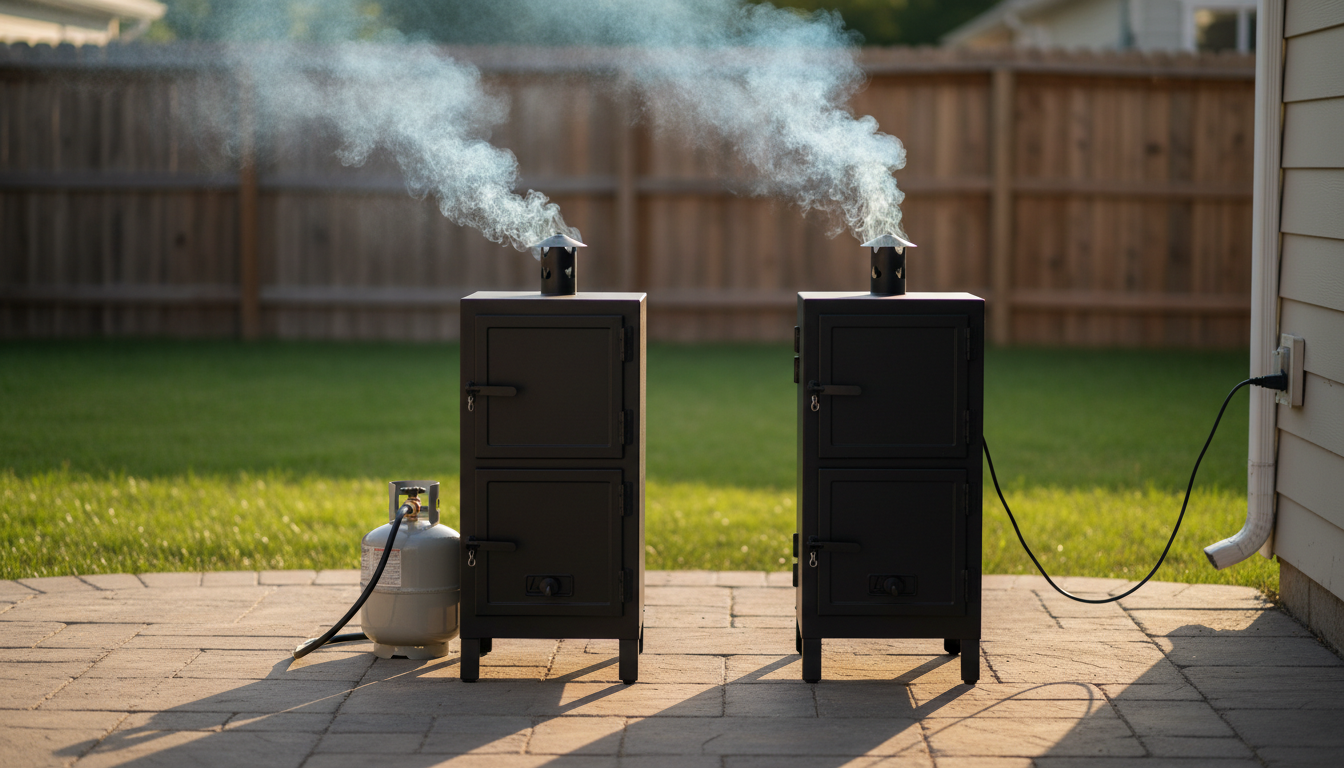
The propane vs electric smoker debate comes down to a handful of tradeoffs: how precisely you can hold a temperature, how the smoker copes with cold and wind, how much smoke flavor ends up in the meat, where you can use it, and what each cook costs. This guide walks through each factor, does the fuel math with clearly labeled assumptions, and suggests a few current models on each side.
Quick Answer: Choose an electric smoker if you want the most hands-off cooking, cook near an outdoor outlet, and care about low running costs; the Masterbuilt 30-Inch Digital Electric Smoker is the easy pick. Choose a propane smoker if you want more heat, better cold-weather performance, a stronger smoke ring, and the freedom to cook anywhere; the Masterbuilt 30-Inch Two Door Propane Smoker offers the best value, and the Masterbuilt 40-Inch ThermoTemp XL adds thermostat control and more space.
Propane and Electric Smokers Compared
| Product | Best For | Key Specs | Approx. Price | Link |
|---|---|---|---|---|
| Masterbuilt 30-Inch Two Door Propane Smoker (MPS 230S) | Best value propane | 15,400 BTU burner, 730 sq in, 4 racks | Around $250 | Check price on Amazon |
| Masterbuilt 40-Inch ThermoTemp XL Propane Smoker | Set and forget propane | Thermostat dial, 960 sq in, 4 racks | Around $400 | Check price on Amazon |
| Char-Broil Vertical Gas Smoker (12701705) | Propane with extra burner power | 16,500 BTU burner, about 595 sq in, 3 racks | Around $350 to $475 | Check price on Amazon |
| Masterbuilt 30-Inch Digital Electric Smoker (MB20071117) | Best overall electric | 800 W element, 710 sq in, 100°F to 275°F | Around $250 | Check price on Amazon |
| Masterbuilt 40-Inch Digital Electric Smoker (MB20072918) | Big batches, electric | 970 sq in, 4 racks, 100°F to 275°F | Around $380 | Check price on Amazon |
| Cuisinart COS-330 30-Inch Electric Smoker | Budget electric with higher heat | 1,500 W element, 548 sq in, 100°F to 400°F | Around $200 to $215 | Check price on Amazon |
We built this comparison from manufacturer specifications, retailer listings, and owner reports. We have not personally tested these smokers, and we note wherever a spec comes from a retailer rather than the brand.
How Propane and Electric Smokers Work
Both types use the same basic layout: a tall insulated cabinet, a heat source at the bottom, a wood chip tray above it, a water pan, and racks stacked on top. The difference is the heat source. A propane smoker burns liquefied petroleum (LP) gas from a standard 20-pound tank through a single burner, and you adjust the heat with a gas valve. An electric smoker uses a heating element, much like an oven, and a thermostat or digital controller switches it on and off to hold your set temperature.
In both cases, the heat smolders wood chips to make smoke. Neither burns wood as its main fuel, so flavor will never match a stick burner offset, but both produce real smoked food with far less effort.
Temperature Control
Electric smokers win this round for most people. A digital electric smoker lets you punch in 225°F and walk away. The controller cycles the element to stay near that number, and many models include a meat probe. Owners report that the cabinet swings a few degrees above and below the setting as the element cycles, which is normal and harmless for barbecue.
Most basic propane smokers use a manual valve, so you adjust the flame and watch a thermometer until the temperature settles. Wind, sun, and outside temperature all move that number, so expect to check in more often. Models with a thermostat valve, such as the Masterbuilt ThermoTemp line, close much of that gap by adjusting the gas flow for you.
One catch for electric: many popular models top out at 275°F. That works for brisket, pork shoulder, and ribs, but crisp poultry skin usually needs 300°F or more. Propane smokers and some electric models, like the Cuisinart COS-330 (rated to 400°F), give you that extra headroom.
Cold-Weather Performance
Propane has a clear edge in winter. A 15,000 to 16,500 British thermal unit (BTU) burner puts out far more heat than an 800-watt element, which equals roughly 2,700 BTU per hour. When the air is freezing or the wind picks up, an electric smoker may run nonstop and still struggle to reach temperature. Owners in cold climates often add an insulated smoker blanket or move the unit out of the wind.
Propane is not perfect in the cold either. Tank pressure drops as temperatures fall, so a nearly empty tank may not keep up on a frigid day, and strong gusts can blow out the flame on some models. Still, if you plan to smoke through a northern winter, propane is the safer bet.
Smoke Flavor and Smoke Ring
Both types get their smoke flavor from wood chips, so the type of wood and how cleanly it smolders matter more than the heat source. Even so, owners and barbecue writers commonly report that propane smokers produce a slightly deeper smoke flavor. A live flame heats the chip box more aggressively, which keeps chips smoldering and helps air move through the cabinet.
The smoke ring, the pink band just under the bark, is where the difference shows most. That ring forms when gases from combustion, mainly nitrogen dioxide, react with the meat’s pigment. Burning propane creates those gases, while an electric element creates none, so electric smokers usually produce a thinner smoke ring or none at all. The ring is cosmetic and does not change taste, but if you care about presentation, propane has the advantage.
Portability: No Outlet Needed
A propane smoker runs anywhere you can bring a tank: a campsite, a tailgate, a hunting cabin, or the far corner of the yard. An electric smoker needs a nearby outdoor outlet, ideally a ground fault circuit interrupter (GFCI) outlet. Most manufacturers discourage extension cords; if you must use one, choose a short, heavy-gauge, outdoor-rated cord and follow your manual.
Weight matters too. Both styles are tall cabinets that typically weigh between 40 and 70 pounds, so neither is truly portable, but propane at least frees you from the house.
Running Costs: Propane Tank vs Kilowatt-Hours
Electric smokers almost always cost less per cook. Here is the math for an 8-hour smoke at 225°F. Your results will vary with weather, insulation, how often you open the door, and local prices, so treat these as rough estimates.
Electric Smoker Math
- Assumption 1: an 800-watt (0.8 kilowatt) element, as used in the Masterbuilt 30-inch digital models.
- Assumption 2: the element runs about 60% of the time once the smoker reaches temperature (our estimate, not a manufacturer figure).
- Assumption 3: electricity costs 18.2 cents per kilowatt-hour (kWh), the US Energy Information Administration (EIA) forecast for the 2026 average residential price.
0.8 kW × 8 hours × 0.60 = about 3.8 kWh. 3.8 kWh × $0.182 = about $0.70 per cook. Even if the element ran the entire time (6.4 kWh), the cost would be about $1.16.
Propane Smoker Math
- Assumption 1: a full 20-pound tank holds about 4.7 gallons of propane, and propane contains about 91,500 BTU per gallon, so a full tank holds roughly 430,000 BTU.
- Assumption 2: at smoking temperatures, the burner averages about 10,000 BTU per hour (our estimate; burners in this class are rated at 15,000 to 16,500 BTU per hour on high).
- Assumption 3: a 20-pound refill costs about $20. Tank exchanges typically cost more, around $20 to $30, and include less propane.
10,000 BTU × 8 hours = 80,000 BTU, or about 19% of a tank. 19% × $20 = about $3.70 per cook. A cold, windy day with the burner on high could push that toward $5 or $6.
Over 20 cooks a year, that works out to roughly $14 for electric and $74 for propane under these assumptions. Neither number will break the bank, but electric is clearly cheaper to run.
Safety
Both types are safe when you follow the manual, and both must stay outdoors. Never run either one in a garage, shed, or enclosed porch, because burning wood chips produce carbon monoxide whether the heat comes from gas or electricity. Keep at least the clearance your manual specifies from walls, fences, and overhangs.
Propane adds gas handling. Check every connection with soapy water before the first cook and after each tank swap; bubbles mean a leak. Store tanks upright and outdoors, and close the valve when you finish. Electric adds water and wiring concerns. Plug into a GFCI outlet, keep the cord and controller dry, and cover the smoker when it is not in use.
Food safety works the same on both. Cook to the safe minimum internal temperatures from the US Department of Agriculture (USDA) safe temperature chart: 165°F for poultry, 160°F for ground meats, and 145°F with a 3-minute rest for whole cuts of pork, beef, veal, and lamb. Use a reliable probe thermometer rather than the door gauge.
Capacity
Capacity depends on cabinet size, not fuel. In the Masterbuilt lineup, the 30-inch propane model lists 730 square inches and the 30-inch electric lists 710, nearly identical. Step up to 40 inches and you get 960 square inches (propane ThermoTemp XL) or 970 square inches (electric). As a rough guide, a 30-inch smoker handles a couple of pork shoulders or a few racks of ribs, while a 40-inch unit suits big family gatherings and full packer briskets.
Price
Upfront prices overlap almost completely. Entry-level 30-inch models on both sides list around $200 to $250, and 40-inch models with thermostats or extra features run around $380 to $450. Remember to budget for a propane tank (roughly $35 to $70 if you don’t already own one) on the gas side. Prices change often, so check current listings.
Side-by-Side Summary
| Factor | Propane Smoker | Electric Smoker |
|---|---|---|
| Temperature control | Manual valve on most models; thermostat on some | Digital set and forget |
| Max temperature | Typically 350°F or more | Often 275°F; some reach 400°F |
| Cold weather | Strong; more heat headroom | Weaker; may need an insulated blanket |
| Smoke ring | Visible ring is common | Thin or none |
| Portability | Runs anywhere with a tank | Needs an outdoor outlet |
| Cost per 8-hour cook (estimate) | About $3.70 | About $0.70 |
| Main safety concern | Gas leaks; check connections | Water and wiring; use a GFCI outlet |
| Typical price | Around $250 to $475 | Around $200 to $450 |
Which Should You Choose?
Choose a Propane Smoker If
- You smoke in cold or windy weather.
- You want to cook away from the house, at camp, or at a tailgate.
- You care about a visible smoke ring and slightly bolder smoke.
- You want temperatures above 275°F for poultry skin.
Choose an Electric Smoker If
- You want the most hands-off cooking possible, including overnight smokes.
- You have a GFCI outlet near your patio.
- You want the lowest cost per cook and no tank refills.
- You mostly smoke in mild weather, or you can shelter the smoker from wind.
Propane Smokers to Consider
Masterbuilt 30-Inch Two Door Propane Smoker (MPS 230S)
This is the classic starter propane smoker. According to Masterbuilt, it pairs a 15,400 BTU stainless steel burner with 730 square inches across four chrome-coated racks. The two-door design lets you add chips and water through the lower door without letting heat escape from the food chamber.
What we like: Strong burner for the price, separate lower door, and solid capacity for a 30-inch cabinet.
Watch out for: Manual temperature control means more babysitting, and owners report the door gauge can read off, so use a separate thermometer.
Best for: First-time buyers who want propane at an entry-level price.
Masterbuilt 40-Inch ThermoTemp XL Propane Smoker
The ThermoTemp XL fixes propane’s biggest weakness. Masterbuilt says its thermostat dial adjusts the gas flow to hold your chosen temperature, and the cabinet offers 960 square inches across four racks with push-button ignition. It gives you much of an electric smoker’s convenience without the cord.
What we like: Thermostat control, large capacity, and propane heat headroom for cold days.
Watch out for: Masterbuilt’s own store showed it out of stock when we checked, so you may need to buy through a retailer. The maximum temperature listing on the product page is inconsistent (350°F vs 375°F).
Best for: Cooks who want propane with near set and forget convenience.
Char-Broil Vertical Gas Smoker (12701705)
Char-Broil’s vertical propane cabinet uses a 16,500 BTU burner, the strongest of our picks. The manufacturer lists about 595 square inches across three adjustable grates plus a small warming rack, along with a water pan.
What we like: Most burner power here, which helps in cold weather.
Watch out for: Less cooking space than the Masterbuilt models, and prices vary widely between retailers.
Best for: Cooks in colder climates who want extra heat.
Electric Smokers to Consider
Masterbuilt 30-Inch Digital Electric Smoker (MB20071117)
This is one of the best-known electric smokers in the US. Masterbuilt lists 710 square inches across four racks, a digital panel that sets temperatures from 100°F to 275°F, and a side wood chip loader so you can add chips without opening the main door. Replacement parts listings show an 800-watt element.
What we like: Simple digital controls, side chip loader, and a large owner community for tips and parts.
Watch out for: The 275°F ceiling limits crispy poultry skin, and Masterbuilt’s own store showed it out of stock when we checked, though major retailers still list it.
Best for: Beginners who want easy, hands-off smoking.
Masterbuilt 40-Inch Digital Electric Smoker (MB20072918)
The bigger sibling offers 970 square inches across four racks with the same 100°F to 275°F digital control. That extra space fits a full brisket or several pork shoulders at once.
What we like: The largest capacity of our picks with the same easy controls.
Watch out for: More cabinet to heat in cold weather, and the same 275°F limit.
Best for: Families and anyone who cooks for a crowd.
Cuisinart COS-330 30-Inch Electric Smoker
Cuisinart takes a different approach with a 1,500-watt element and a dial that ranges from 100°F to 400°F, according to Home Depot’s listing. It has 548 square inches across three dishwasher-safe racks.
What we like: A higher top temperature than most electric smokers and a stronger element for cooler days.
Watch out for: Analog dial control is less precise than a digital panel, and capacity is the smallest here.
Best for: Budget buyers who want an electric smoker that can also handle poultry.
Related Guides
Frequently Asked Questions
Does food taste better from a propane or electric smoker?
Many owners report slightly stronger smoke flavor from propane, mostly because the flame keeps wood chips smoldering more steadily. The difference is modest, and your choice of wood and technique matters more.
Why don’t electric smokers make a smoke ring?
The smoke ring forms when combustion gases react with pigment in the meat. An electric element burns no fuel, so it produces far fewer of those gases. The ring is visual only and does not affect taste or doneness.
How long does a 20-pound propane tank last in a smoker?
Under our assumption of about 10,000 BTU per hour at smoking temperatures, a full tank lasts roughly 40 hours. Cold weather and higher settings shorten that a lot, so keep a spare tank for long cooks.
Is an electric vs gas smoker better for beginners?
Electric is usually easier for beginners because the digital controller holds temperature for you. A propane smoker with a thermostat, like the Masterbuilt ThermoTemp XL, is a good middle ground.
Can I use an electric smoker in the rain or snow?
Check your manual first. In general, keep the controller and cord dry, plug into a GFCI outlet, and use a covered area that is still open to fresh air. Never move a smoker into a garage to escape the weather.
Final Verdict
If convenience and low running costs top your list, go electric. The Masterbuilt 30-Inch Digital Electric Smoker is the simplest way to start, and the Cuisinart COS-330 adds higher heat on a budget. If you smoke in the cold, want to cook away from an outlet, or care about a smoke ring, go propane. The Masterbuilt 30-Inch Two Door Propane Smoker delivers the best value, while the 40-Inch ThermoTemp XL brings thermostat control to gas. Either way, you will be making real barbecue with far less fuss than a charcoal or wood smoker.
Leave a Reply