The Smoking Yard is reader supported. When you buy through links on our site, we may earn an affiliate commission. As an Amazon Associate, we earn from qualifying purchases.
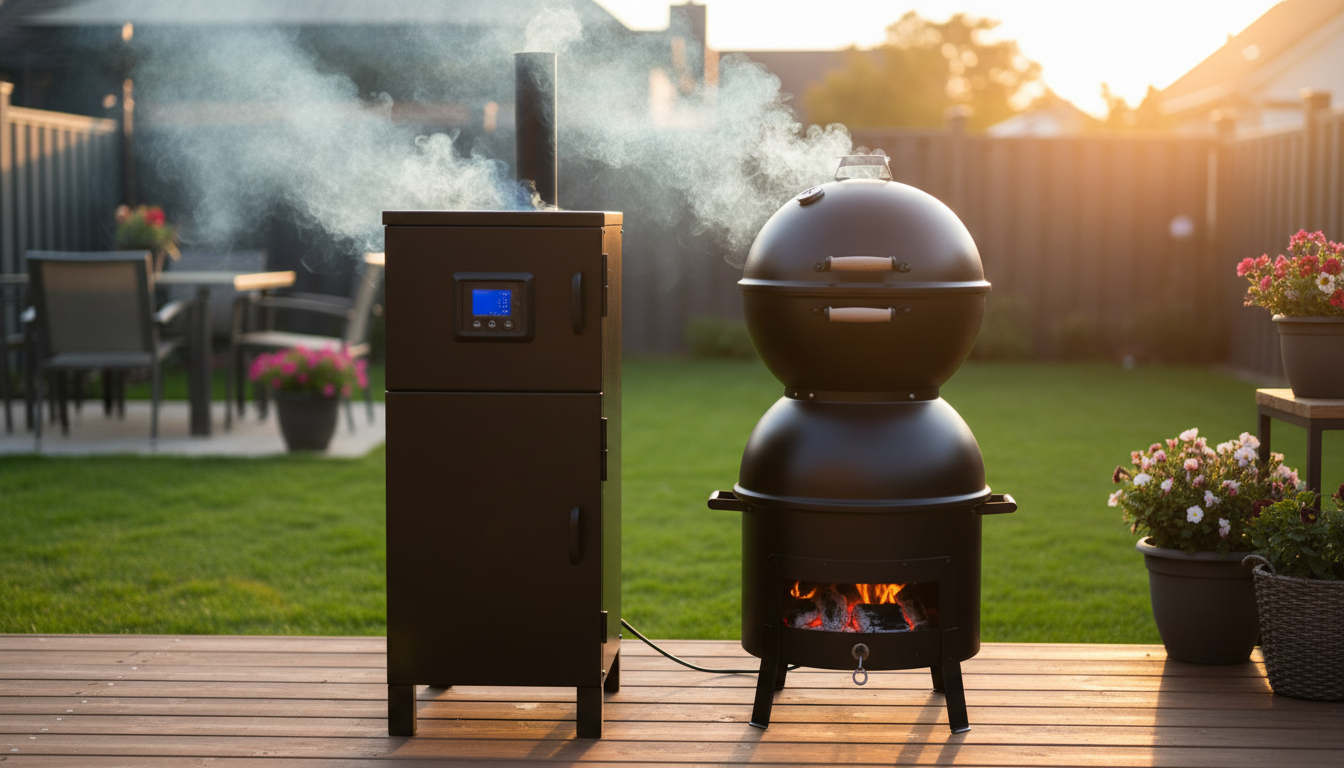
Picking your first smoker usually comes down to one question: do you want convenience or do you want that deep, smoky, crusty barbecue you get from burning real fuel? The electric smoker vs charcoal debate is really a trade between time, money, and flavor, and neither side wins on every count.
Electric smokers plug into a wall outlet, hold a set temperature on their own, and let you walk away. Charcoal smokers ask more of you, but they reward the effort with a darker bark, a stronger smoke ring, and more versatility. Below, we compare the two on flavor, effort, fuel cost, temperature control, cleanup, portability, and price, then suggest a few models on each side that are currently available.
Quick Answer: If you want hands-off smoking with the least effort, get an electric smoker such as the Masterbuilt 30-Inch Digital Electric Smoker. If flavor and bark matter most, go charcoal: the Weber Smokey Mountain Cooker is the classic all-rounder, the Pit Barrel Cooker is the easiest charcoal option, and the Char-Griller AKORN Kamado gives you a smoker and a high-heat grill in one.
Our Top Picks at a Glance
| Product | Best For | Key Specs | Approx. Price | Link |
|---|---|---|---|---|
| Masterbuilt 30-Inch Digital Electric Smoker (MB20071117) | Set-and-forget beginners | Electric, 710 square inches over 4 racks, 100°F to 275°F, side wood chip loader | Around $250 | Check price on Amazon |
| Weber Smokey Mountain Cooker, 18-Inch | Classic charcoal flavor with long, stable cooks | Charcoal water smoker, 481 square inches over 2 grates, water pan | Around $420 | Check price on Amazon |
| Pit Barrel Cooker, 18.5-Inch Classic | Easiest charcoal smoking | Charcoal drum smoker, hanging hooks and rods, grill grate, 30-gallon drum | Around $430 | Check price on Amazon |
| Char-Griller AKORN Kamado Charcoal Grill | Smoking and searing on one cooker | Triple-wall insulated steel kamado, 445 square inches total, 200°F to 700°F | Around $400 list, often less on sale | Check price on Amazon |
Prices change often, so treat these as rough ranges and check the current price before you buy.
How Electric and Charcoal Smokers Work
An electric smoker uses a thermostat-controlled heating element, much like an oven, with a small tray of wood chips that smolders for smoke. A charcoal smoker burns lit coals, usually topped with hardwood chunks, and you control the heat with air vents (dampers). That live fire creates more smoke and combustion gases, which explains most of the differences below.
Flavor and Bark
This is where charcoal pulls ahead. Burning charcoal and wood chunks gives food a deeper, richer smoke flavor, and the dry heat of a live fire helps build a firm, dark bark on brisket and pork shoulder.
Electric smokers produce a lighter smoke flavor. Their cabinets seal tightly and hold a lot of moisture, so owners often report a softer bark. The milder taste works well on fish, cheese, and poultry, but charcoal gets you closer to competition-style brisket. Owners who want more bark from an electric unit often finish the meat unwrapped or move it to a hot grill for the last stretch.
Smoke Ring
The pink smoke ring under the surface of smoked meat comes from gases released by burning fuel, mainly nitrogen dioxide and carbon monoxide, reacting with the myoglobin in meat. A charcoal fire gives off plenty of these gases, so charcoal smokers produce a clear, thick ring.
Electric smokers smolder only a small amount of wood, so the ring is usually faint or missing. That’s a looks issue more than a taste issue: the smoke ring itself adds little flavor. If you cook for guests who judge barbecue by that pink band, though, charcoal makes a better first impression.
Learning Curve
Electric smokers are close to foolproof. You set a temperature on the digital panel, add chips, load the meat, and wait. A first-timer can turn out good pulled pork on day one.
Charcoal takes practice. You need to learn how to light a fire, how many coals to use, how the vents respond, and how weather changes everything. Most beginners overshoot their target temperature on the first few cooks, because closing vents slows a fire gradually, not instantly. Some charcoal designs flatten the curve: the Pit Barrel Cooker uses one intake setting based on your altitude, and the Weber Smokey Mountain’s water pan acts as a heat buffer that forgives small mistakes.
Babysitting Time
With an electric smoker, your main job is reloading wood chips. Chip trays are small, so you’ll add chips every so often during the first few hours, which is when meat absorbs most of its smoke. Models with a side loader, like the Masterbuilt, let you add chips without opening the door. After that, you can run errands or sleep through an overnight cook.
Charcoal smokers need more check-ins. Expect to watch the thermometer closely for the first hour while the fire settles, then make small vent tweaks every hour or two. On long cooks you may need to add fuel, and wind, rain, or cold weather can push temperatures around. Owners of well-built models like the Weber Smokey Mountain report long, steady stretches, but you still need to stay nearby.
Fuel Costs
Electric smoking is cheap to run. The Masterbuilt 30-Inch uses an 800-watt element, according to AmazingRibs’ review of the model. Even if the element ran nonstop for a 10-hour cook, that would use 8 kilowatt-hours (kWh). The US Energy Information Administration (EIA) projects the average residential electricity price at about 18.2 cents per kWh in 2026, so the worst case is roughly $1.50 in power. In practice the thermostat cycles the element on and off, so the real cost is often lower. Add a few dollars of wood chips per cook.
Charcoal costs more per cook. A 16-pound bag of Kingsford Original briquettes usually sells for somewhere around $7 to $15 depending on the store and sales, and a long smoke can use a good portion of a bag, plus wood chunks. Kamados use less fuel because their insulated walls hold heat, and you can snuff the fire and reuse leftover lump charcoal next time. Over a season, electric is clearly cheaper to fuel.
Temperature Stability and Range
Electric smokers win on stability. A thermostat holds a set temperature without your input, which makes them ideal for low-temperature jobs like smoking cheese, jerky, or salmon. The catch is the ceiling: the Masterbuilt 30-Inch tops out at 275°F, according to the manufacturer. That’s fine for low and slow, but too cool for crisp poultry skin or hot and fast brisket. Cold weather can also slow electric units, since the element has to work harder to keep up.
Charcoal smokers swing more, but they reach far higher temperatures. A kamado like the Char-Griller AKORN is rated from 200°F to 700°F, so it can smoke ribs in the afternoon and sear steaks at dinner. Vertical charcoal smokers like the Weber Smokey Mountain usually run in the classic 225°F to 300°F range with the water pan in, and hotter without it.
Cleanup
Electric smokers have no ash. You empty the chip tray and drip pan, wipe the racks, and you’re done.
Charcoal means dealing with ash after every cook. Let it cool completely (it can stay hot for a long time) before you dump it into a metal container. Water smokers also have a greasy water pan to empty. Kamados with a pull-out ash pan, like the AKORN’s dump-style pan, make this much easier.
Portability and Setup
Electric smokers are fairly light (the Masterbuilt 30-Inch weighs about 42 pounds, based on retailer listings), but they need an outlet. That limits them at campsites and tailgates unless you bring a generator. Check the manual before using an extension cord, since manufacturers often have specific rules for them.
Charcoal smokers go anywhere you can bring a bag of coals. The Weber Smokey Mountain (about 47 pounds) and the Pit Barrel Cooker break into a few pieces for travel. The AKORN Kamado is a different story: at nearly 90 pounds on a cart, it’s a backyard fixture, not a tailgate cooker.
Price
Entry-level electric smokers usually cost less up front. The Masterbuilt 30-Inch Digital lists at around $250 on the manufacturer’s site, and you can find basic analog electric units for less. Quality charcoal smokers like the Weber Smokey Mountain and Pit Barrel Cooker sit around $400 to $450, though cheaper charcoal options exist. Budget electric units also tend to have lighter construction. Weber, by contrast, backs the Smokey Mountain’s bowl, lid, and center section with a 10-year rust-through warranty, according to BBQGuys’ listing, which is far longer than most budget electric smokers offer.
Electric vs Charcoal Smoker: Side-by-Side
| Factor | Electric Smoker | Charcoal Smoker |
|---|---|---|
| Flavor | Mild, clean smoke | Deeper, richer smoke |
| Bark | Softer (moist cabinet) | Firmer and darker |
| Smoke ring | Faint or none | Clear and thick |
| Learning curve | Very easy | Moderate; takes a few cooks |
| Babysitting | Minimal; refill chips early on | Regular vent and fuel checks |
| Fuel cost per long cook | Usually under $2 in power plus chips | Several dollars in charcoal plus wood |
| Temperature stability | Excellent | Good once you learn the vents |
| Max temperature | Often around 275°F | Up to about 700°F on a kamado |
| Cleanup | Easy; no ash | Ash disposal after every cook |
| Portability | Needs an outlet | Works anywhere |
| Typical price | Around $250 for a good digital model | Around $400 for a quality smoker |
Which One Should You Choose?
Choose an Electric Smoker If
- You want to set a temperature and walk away for hours.
- You’re brand new to smoking and want good results right away.
- You plan to smoke cheese, fish, jerky, or other low-temperature foods.
- You live where open fires or charcoal are restricted, such as some apartments and condos (check your building rules first).
- You want the lowest upfront and running costs.
Choose a Charcoal Smoker If
- You care most about deep smoke flavor, firm bark, and a visible smoke ring.
- You enjoy managing a fire and treating barbecue as a hobby.
- You want to grill and sear as well as smoke.
- You want to cook away from power outlets, at camp or on the road.
- You want a smoker built to last many seasons.
Best Electric Smoker Pick
Masterbuilt 30-Inch Digital Electric Smoker (MB20071117)
This is one of the most common first smokers in American backyards. Based on the manufacturer’s specs, it offers 710 square inches of space across four chrome-coated racks, a digital control panel with a 100°F to 275°F range, and a patented side wood chip loader so you can add chips without letting heat and smoke escape. Masterbuilt also sells a version with a glass window and legs for a little more.
What we like: Simple digital controls, plenty of rack space for the price, and the side chip loader cuts down on door opening.
Watch out for: The 275°F ceiling rules out crispy poultry skin, the lightweight build is typical of budget electric units, and Masterbuilt’s own site sometimes shows it out of stock, so check retailers too.
Best for: Beginners and busy cooks who want reliable, hands-off smoking.
Best Charcoal Smoker Picks
Weber Smokey Mountain Cooker, 18-Inch
The Weber Smokey Mountain (often called the WSM by owners) is a vertical charcoal water smoker that many pitmasters recommend as the best first charcoal smoker. Based on retailer specs, the 18-inch model has two 17.5-inch cooking grates for 481 square inches total, a porcelain-enameled water pan, and a built-in lid thermometer. A larger 22-inch version costs more and fits bigger cooks.
What we like: Owners report very stable temperatures once the vents are dialed in, the water pan buffers temperature swings, and the 10-year rust-through warranty on the main body is generous.
Watch out for: The access door is small, and the water pan adds a messy cleanup step.
Best for: Cooks who want true charcoal flavor with a forgiving learning curve.
Pit Barrel Cooker, 18.5-Inch Classic
The Pit Barrel Cooker is a steel drum smoker built around simplicity. You hang meat from hooks inside the drum over a basket of charcoal, and drippings hit the coals to create flavorful smoke. According to the manufacturer, the Classic package includes eight stainless steel hooks, two hanging rods, a charcoal basket, a grill grate, a stand, and two rubs, and it fits up to eight racks of ribs or two turkeys of 13 to 16 pounds.
What we like: Almost no vent management (you set one intake based on your altitude), a complete kit out of the box, and a big capacity for the footprint.
Watch out for: It runs a bit hotter than classic low and slow, and fine temperature control is limited by design.
Best for: Beginners who want charcoal flavor without learning to manage a fire.
Char-Griller AKORN Kamado Charcoal Grill
Kamados are egg-shaped cookers that hold heat well, and the AKORN offers that design at a fraction of the price of ceramic models. Based on Char-Griller’s specs, it has triple-walled insulated steel construction, cast iron cooking grates, 310 square inches of primary space (445 total with the warming rack), dual adjustable dampers, an easy-dump ash pan, and a 200°F to 700°F range.
What we like: One cooker handles low and slow smoking, roasting, and high-heat searing, and the insulated body sips fuel compared with uninsulated smokers.
Watch out for: Reviewers note that it heats up quickly and is hard to bring back down if you overshoot, so you need to sneak up on your target temperature. You’ll also want a heat deflector (Char-Griller sells one called the Smokin’ Stone) for indirect smoking.
Best for: Cooks who want one charcoal cooker for both smoking and grilling.
Buying Guide: What to Look For
Cooking Space
Think about the biggest cook you’ll do, like a whole brisket or several pork shoulders for a party. Square inches on a spec sheet can include small upper racks, so look at the size of each rack too.
Temperature Range
For pure low and slow, 225°F to 275°F covers it. If you want crisp chicken skin or the option to grill, choose a charcoal smoker or kamado that runs hotter.
Build Quality and Warranty
Thicker steel, good door seals, and long warranties usually mean a smoker that holds heat better and lasts longer. Read the warranty terms before you buy, especially on budget units.
A Good Meat Thermometer
Whichever smoker you choose, cook to internal temperature, not time. The US Department of Agriculture (USDA) lists safe minimums of 145°F with a 3-minute rest for whole cuts of beef and pork, 160°F for ground meats, and 165°F for all poultry. See the USDA safe minimum internal temperature chart for the full list. Brisket and pork shoulder are safe well before they’re tender; cooks take them much higher so the connective tissue breaks down.
Related Guides
Frequently Asked Questions
Does an electric smoker taste as good as charcoal?
Electric smokers make tasty food, but the smoke flavor is lighter and the bark is softer. Most people can taste the difference side by side, especially on brisket. On fish, cheese, and poultry, the gap is smaller.
Can you get a smoke ring in an electric smoker?
Usually only a faint one. The ring forms when combustion gases react with meat, and electric smokers burn very little fuel. Some owners add more wood chips to deepen the smoke, but never put charcoal in an electric smoker unless the manual allows it.
Is it cheaper to smoke with electric or charcoal?
Electric is cheaper per cook. A long smoke on an 800-watt unit typically costs under $2 in electricity at average US rates, plus wood chips. Charcoal often runs several dollars per cook, depending on the cooker and the weather.
Which is better for beginners, electric or charcoal?
Electric is easier for a true beginner. If you want charcoal flavor without a steep learning curve, the Pit Barrel Cooker and Weber Smokey Mountain are both known as beginner-friendly charcoal options.
Final Verdict
Choose an electric smoker if you value convenience, steady temperatures, easy cleanup, and low running costs. The Masterbuilt 30-Inch Digital Electric Smoker is a simple, affordable way to start. Choose charcoal if flavor, bark, and versatility matter more than saving time. The Weber Smokey Mountain Cooker is the best all-around pick, the Pit Barrel Cooker is the easiest charcoal smoker to learn, and the Char-Griller AKORN Kamado is the one to get if you also want a high-heat grill.
Leave a Reply