The Smoking Yard is reader supported. When you buy through links on our site, we may earn an affiliate commission. As an Amazon Associate, we earn from qualifying purchases.
Few backyard debates run as long as this one. Charcoal fans swear by the bark, the smoke ring, and the ritual of managing a fire. Pellet fans point out that they slept through the night while their brisket cooked itself. Both camps have a point.
This guide settles the charcoal vs pellet smoker question factor by factor: flavor, convenience, temperature control, searing, fuel cost per cook, cleanup, learning curve, weather, electricity, and price. You will also find proven picks for each side, plus a hybrid option. We have not cooked on these smokers ourselves; specs come from manufacturer pages, major retailers, and owner communities.
Quick Answer: Choose a pellet grill if you want set-it-and-forget-it smoking, app control, and consistent results with almost no fire management; the Traeger Woodridge and Z Grills 700D are strong starting points. Choose charcoal if you want deeper smoke flavor, real searing heat, and a lower entry price; the Weber Smokey Mountain Cooker and a Weber Kettle with a Slow ‘N Sear insert are the classic picks. If you want both, look at the Masterbuilt Gravity Series 800, a charcoal smoker with a digital fan controller.
Charcoal vs Pellet Smoker Comparison Table
| Product | Best For | Key Specs | Approx. Price | Link |
|---|---|---|---|---|
| Weber Smokey Mountain Cooker 18″ | Classic charcoal smoking | Charcoal water smoker, 2 racks, 481 square inches total | Around $420 | Check price on Amazon |
| Weber Original Kettle Premium 22″ + Slow ‘N Sear | Budget smoke and sear | 363 square inches, 2-zone stainless insert, 8+ hours at 225°F to 250°F (maker’s claim) | Around $220 plus $70 to $100 | Check price on Amazon |
| Kamado Joe Classic Joe II 18″ | Year-round cooking, high heat | Ceramic kamado, 225°F to 750°F, about 231 pounds | Around $1,000 to $1,500 | Check price on Amazon |
| Z Grills 700D | Budget pellet smoking | 697 square inches, 180°F to 450°F, digital controller | Around $600 to $800 | Check price on Amazon |
| Traeger Woodridge | Beginners who want app control | 860 square inches, up to 500°F, 24-pound hopper, WiFIRE | Around $900 | Check price on Amazon |
| recteq Backyard Beast 1200 | Big cooks and higher heat | 1,200 square inches, 180°F to 700°F, 30-pound hopper, PID control | Around $1,050 to $1,200 | Check price on Amazon |
| Masterbuilt Gravity Series 800 | Charcoal flavor with automation | Gravity-fed charcoal, 225°F to 700°F, Wi-Fi and Bluetooth | Around $700 | Check price on Amazon |
How Each Smoker Works
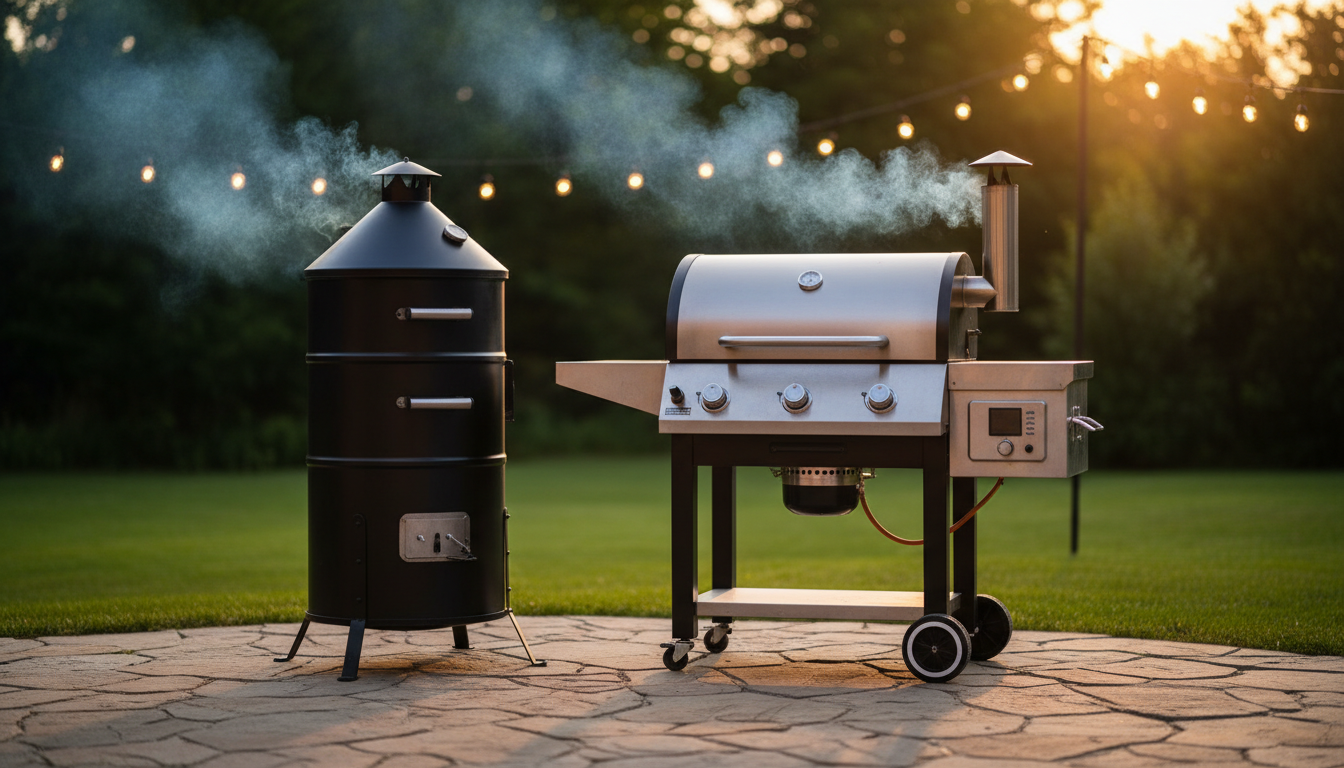
A charcoal smoker burns lump charcoal or briquettes, usually with wood chunks for extra smoke, and you control heat with the air vents.
A pellet smoker (often called a pellet grill) burns compressed hardwood pellets. An electric auger feeds them into a fire pot, and a digital controller adjusts the feed to hold your set temperature, much like an oven thermostat.
Flavor
Charcoal wins on smoke intensity. A charcoal fire with wood chunks produces a heavier, more pronounced smoke flavor and, in many owners’ experience, a darker bark and a more visible smoke ring. If you grew up on Texas brisket or Carolina pork, charcoal gets you closer to that taste.
Pellet grills burn very efficiently, which means a cleaner, milder smoke. Many people actually prefer that, especially for poultry, fish, and family members who find heavy smoke bitter. Some models add a smoke boost setting (Traeger calls it Super Smoke on some Woodridge models), and many owners add a smoke tube.
Edge: Charcoal, unless you prefer a lighter smoke.
Convenience
Pellet grills win this one easily. You fill the hopper, press a button, pick a temperature, and walk away. Most current models also connect to a phone app over Wi-Fi.
Charcoal takes more hands-on time: you light a chimney, add wood, and tweak the vents until the temperature settles, then check in periodically.
Edge: Pellet.
Temperature Control
Pellet controllers typically hold a set temperature within a narrow band, and models with a proportional integral derivative (PID) controller, such as the recteq Backyard Beast, adjust the pellet feed constantly to stay close to the target.
Charcoal smokers can hold remarkably steady temperatures too. The Weber Smokey Mountain and ceramic kamados both have loyal followings for exactly this reason. The catch: changes happen slowly, and an overshoot takes patience to fix. An aftermarket fan controller or a gravity-fed smoker (below) adds push-button control.
Edge: Pellet.
Searing and High-Heat Grilling
Charcoal dominates here. A kettle with a Slow ‘N Sear insert concentrates coals into a searing zone that the maker rates at over 1,000°F, and a kamado like the Kamado Joe Classic Joe II reaches 750°F according to its specs.
Many pellet grills top out around 450°F to 500°F (the Z Grills 700D lists 450°F, and the Traeger Woodridge lists 500°F). That falls short for a steakhouse sear, though higher-heat models like the recteq Backyard Beast 1200 (700°F) close the gap.
Edge: Charcoal.
Fuel Cost per Cook
Fuel costs vary with brand, weather, and cook size, so treat these as ballpark figures.
Kingsford estimates that a pellet grill uses about 1 pound of pellets per hour on low heat and about 2 pounds per hour on high heat. A 12-hour pork shoulder cook at 225°F to 250°F could use roughly 12 to 18 pounds of pellets, often close to a full bag.
Charcoal use varies by smoker. Insulated kamados sip fuel and often finish long cooks with charcoal left over. Because you can snuff the fire and reuse leftover coals, the real cost per cook often lands at or below pellets.
Edge: Roughly even, with charcoal slightly cheaper in efficient cookers.
Cleanup and Maintenance
Charcoal produces more ash, especially briquettes. Ash sweeps and drawers help, but you will still dump ash after most cooks.
Pellet grills produce little ash per cook, but they need regular vacuuming of the fire pot, plus scraping of the grease tray and drip bucket. Skipping fire pot cleaning can cause flameouts. Pellets also need dry storage; damp pellets swell and can jam the auger.
Edge: Pellet for routine cleanup, charcoal for simplicity (there are no electronics or augers to fail).
Learning Curve
A first-time pellet owner can turn out good ribs on day one because the controller handles the fire.
Charcoal takes a few cooks to learn. You need to understand vent settings, how much fuel to load, and how to recover from temperature swings. Those skills carry over to any charcoal grill or offset smoker. If an offset is your long-term goal, our guide to the best offset smokers explains what fire management looks like on a bigger pit.
Edge: Pellet.
Weather Performance
Cold, wind, and rain affect every smoker. Thin-walled pellet grills burn noticeably more pellets in winter, and some struggle to reach high temperatures in freezing wind. Insulated blankets help, and the hopper must stay dry.
Thick ceramic kamados handle cold weather better than almost anything else, which is why many northern cooks use them year-round. Steel charcoal smokers like the Weber Smokey Mountain and Weber kettle burn more fuel in the cold but have no electronics to protect from the rain.
Edge: Charcoal, especially kamados.
Electricity Needs
Every pellet grill needs power for its controller, auger, fan, and igniter, so you need an outlet at home and a generator or power station on the road. See our best portable pellet smokers guide for travel options.
Charcoal smokers need no power at all. They work anywhere, even during an outage.
Edge: Charcoal.
Price
Charcoal has the lower entry point: around $300 for a Weber kettle plus Slow ‘N Sear and around $420 for the Weber Smokey Mountain 18″. Ceramic kamados cost more, around $1,000 to $1,500.
Decent pellet grills start around $500 to $600 and climb quickly to $1,000 and up. Prices change often, so check before you buy.
Edge: Charcoal.
Side-by-Side Summary
| Factor | Charcoal Smoker | Pellet Smoker |
|---|---|---|
| Flavor | Stronger smoke, darker bark | Cleaner, milder smoke |
| Convenience | Hands-on fire management | Push button, app control |
| Temperature control | Steady once dialed in, slow to adjust | Precise, digital |
| Searing | Excellent | Limited on most models |
| Fuel cost per cook | Low, leftover coals reusable | About 1 to 2 pounds per hour |
| Cleanup | More ash to dump | Fire pot vacuuming, grease tray |
| Learning curve | Moderate | Easy |
| Weather | Kamados excel in cold | Uses more pellets in cold, keep dry |
| Electricity | None | Required |
| Price | Around $220 to $1,500 | Around $500 to $1,200+ |
Choose Charcoal If / Choose Pellet If
Choose a Charcoal Smoker If You:
- Want the boldest smoke flavor and bark
- Plan to sear steaks and burgers on the same cooker
- Have a tighter budget
- Cook where power is not available
- Enjoy tending a fire and learning the craft
Choose a Pellet Smoker If You:
- Want to start a cook and walk away
- Like checking temperatures from a phone app
- Prefer a milder smoke flavor
- Cook overnight or while you work
- Want consistent results with minimal practice
Still weighing other fuel types? Our comparisons of electric vs charcoal smokers and pellet vs electric smokers cover the remaining matchups.
Best Charcoal Smokers to Consider
Weber Smokey Mountain Cooker 18″
This bullet-style water smoker has been a backyard favorite for decades. According to retailer specs, the 18-inch model offers 481 square inches across two cooking racks, a built-in lid thermometer, and a water pan that helps stabilize temperature. Weber backs the bowl, lid, and center section with a 10-year warranty against rust-through.
What we like: Owners report very steady low-and-slow temperatures once the vents are set, and it needs no power.
Watch out for: It smokes well but does not grill or sear well.
Best for: Beginners who want a dedicated charcoal smoker without a big investment.
Weber Original Kettle Premium 22″ with Slow ‘N Sear
The 22-inch Weber kettle gives you 363 square inches of grilling space, a hinged grate for adding fuel, and One-Touch ash cleanup. Add the Slow ‘N Sear Original, a stainless steel insert for 22-inch kettles, to turn it into a smoker. The maker claims 8+ hours at 225°F to 250°F on one chimney of briquettes, a built-in water reservoir, and a searing zone above 1,000°F.
What we like: One cooker handles both smoking and high-heat searing for around $300 total.
Watch out for: Cooking space is limited for big cooks, and a full packer brisket is a tight fit.
Best for: Budget buyers who want one grill that does it all.
Check price on Amazon (kettle) | Check price on Amazon (Slow ‘N Sear)
Kamado Joe Classic Joe II 18″
This ceramic kamado smokes, grills, roasts, and bakes. Per retailer specs, it runs from 225°F to 750°F and works with the Divide and Conquer multi-level cooking system. It also has an Air Lift hinge that makes the heavy dome easier to lift, a slide-out ash drawer, and a cart with locking wheels.
What we like: Thick ceramic walls hold heat in cold weather and use charcoal efficiently, and it reaches true searing temperatures.
Watch out for: It weighs about 231 pounds, costs more than other charcoal options, and offers a modest 18-inch cooking surface.
Best for: Cooks who want one premium charcoal cooker for every season.
Best Pellet Smokers to Consider
Z Grills 700D
Z Grills’ popular midsize model offers, according to the maker, 697 square inches across two racks and a temperature range of 180°F to 450°F with a digital controller.
What we like: Lots of cooking space for the money, and owners report reliable, simple operation.
Watch out for: The base 700D lacks Wi-Fi, and its 450°F ceiling limits searing. Z Grills sells Wi-Fi versions at a higher price.
Best for: First-time pellet buyers on a budget.
Traeger Woodridge
The Woodridge replaced Traeger’s long-running Pro Series as the brand’s main entry line. Traeger lists 860 square inches of cooking space, a 500°F maximum, a 24-pound hopper, a full-color digital controller, and WiFIRE app control on the base model.
What we like: A polished app, wide dealer support, and generous cooking space for the price.
Watch out for: It costs more than budget brands with similar space, and the base model skips Super Smoke.
Best for: Beginners who want a trusted brand and easy app control.
recteq Backyard Beast 1200
recteq focuses on heavy build quality and precise control. According to the manufacturer, the Backyard Beast 1200 offers 1,200 square inches, a range of about 180°F to 700°F, PID temperature control, stainless steel components, and app connectivity. Retailers list a 30-pound hopper.
What we like: The 700°F top end makes it one of the better pellet options for searing, and the huge capacity handles parties.
Watch out for: It is large, heavy, and priced well above entry-level pellet grills.
Best for: Big families and cooks who want pellet convenience with higher heat.
Pit Boss is another popular value brand worth a look, especially if you want something compact. See our Pit Boss portable pellet grill comparison for details.
The Middle Option: Gravity-Fed Charcoal
Gravity-fed smokers feed charcoal from a tall hopper down into a firebox, while a digital controller runs a fan to hold your set temperature. You get real charcoal flavor with dial-and-walk-away control.
The Masterbuilt Gravity Series 800 is the best-known example. Its specs list a 225°F to 700°F range, a hopper that holds about 10 pounds of lump charcoal or 16 pounds of briquettes, and Wi-Fi and Bluetooth control through an app. It sells for around $700, with the smaller 560 and larger 1050 bracketing it.
What we like: Charcoal flavor and searing heat with pellet-style convenience.
Watch out for: It still needs electricity, and the hopper and controller need protection from rain.
Best for: Cooks torn between the two camps.
Buying Guide: What Matters Most
- How often you cook: Busy weekly smokers value convenience; occasional cooks may enjoy the charcoal ritual.
- Cooking space: One pork butt fits almost anywhere. Two briskets or a dozen racks of ribs call for 700+ square inches.
- Searing needs: If you grill steaks as often as you smoke, charcoal, a kamado, or a high-heat pellet model makes sense.
- Power and location: Pellet and gravity-fed smokers need an outlet. Charcoal works anywhere.
- Total cost: Budget for a good probe thermometer, a cover, and fuel. Our list of smoker accessories every beginner needs covers the essentials.
Whichever smoker you choose, cook to internal temperature, not time. The US Department of Agriculture (USDA) lists safe minimum internal temperatures of 145°F (with a 3-minute rest) for whole cuts of beef and pork, 160°F for ground meats, and 165°F for poultry in its safe temperature chart. Brisket and pork shoulder are usually cooked well past those minimums for tenderness.
Related Guides
- Electric Smoker vs Charcoal Smoker: Flavor, Effort, and Cost Compared
- Pellet Smoker vs Electric Smoker: Which Should You Buy?
- Best Offset Smokers for Every Budget (2026)
- Smoker Accessories Every Beginner Needs (and What to Skip)
Frequently Asked Questions
Does a pellet grill taste as good as charcoal?
It tastes different. Pellet grills produce a cleaner, lighter smoke, while charcoal with wood chunks gives a stronger smoke flavor. A smoke tube or smoke boost setting narrows the gap.
Pellet vs charcoal smoker: which is better for beginners?
A pellet grill is easier for most beginners because the controller manages the fire. That said, a Weber Smokey Mountain or kettle with a Slow ‘N Sear is very forgiving and teaches fire management for a lower price.
Which is cheaper to run, pellet grill vs charcoal?
They are close. A pellet grill burns roughly 1 to 2 pounds of pellets per hour, according to Kingsford. Efficient charcoal cookers, especially kamados, can cost less per cook because you can reuse leftover charcoal.
What is a gravity-fed charcoal smoker?
It is a charcoal smoker with a hopper that feeds coals down into the fire and a digital fan that holds the temperature. The Masterbuilt Gravity Series is the best-known example. It combines charcoal flavor with pellet-style control but still needs electricity.
Final Verdict
If convenience and consistency top your list, buy a pellet grill. The Traeger Woodridge is an easy recommendation for beginners, the Z Grills 700D stretches a tight budget, and the recteq Backyard Beast 1200 adds high heat and huge capacity.
If flavor, searing, and value matter more, go charcoal. A Weber Kettle with a Slow ‘N Sear is a great value, the Weber Smokey Mountain is a proven dedicated smoker, and the Kamado Joe Classic Joe II does everything well in any season.
Can’t decide? The Masterbuilt Gravity Series 800 splits the difference.
Leave a Reply