The Smoking Yard is reader supported. When you buy through links on our site, we may earn an affiliate commission. As an Amazon Associate, we earn from qualifying purchases.
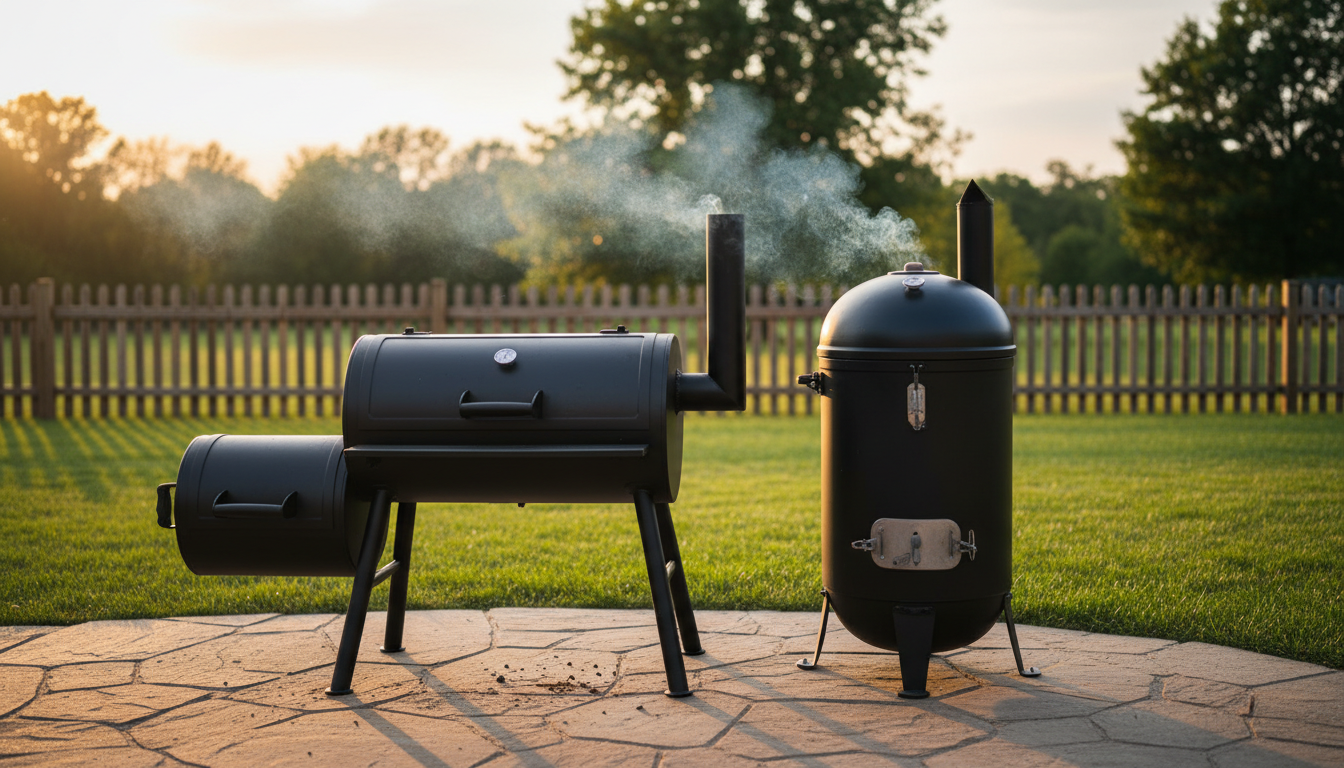
Walk into any big box store in spring and you will see two shapes of smoker: long horizontal barrels with a small box bolted to one end, and tall cabinets or bullet-shaped drums that stand upright. The first is an offset smoker. The second is a vertical smoker. Both turn tough cuts into tender barbecue, but they work in very different ways.
This guide breaks down the offset smoker vs vertical debate factor by factor: footprint, capacity, heat flow, fuel, effort, flavor, price, and portability. By the end, you will know which style fits your yard, your schedule, and the way you like to cook.
Quick Answer: Choose an offset smoker, like the Oklahoma Joe’s Highland or the Char-Griller Smokin’ Pro, if you want to cook with wood, enjoy tending a fire, and have room for a long cooker. Choose a vertical smoker, like the Weber Smokey Mountain Cooker, the Masterbuilt 30-Inch Digital Electric Smoker, or the Pit Boss Pro Series 4-Series vertical pellet smoker, if you want a small footprint, steadier temperatures, and less babysitting.
Offset vs Vertical Smokers: Our Picks Compared
| Product | Best For | Key Specs | Approx. Price | Link |
|---|---|---|---|---|
| Oklahoma Joe’s Highland Offset Smoker | Classic stick burner cooking | Offset, charcoal and wood, 619 sq in main grate plus 281 sq in firebox grate | Around $350 | Check price on Amazon |
| Char-Griller Smokin’ Pro | Budget grill and smoker combo | Offset, charcoal and wood, 580 sq in primary, 1,130 sq in total | Around $300 | Check price on Amazon |
| Weber Smokey Mountain Cooker 22″ | Charcoal smoking with little fuss | Vertical, charcoal, 726 sq in on two grates, water pan | Around $550 to $650 | Check price on Amazon |
| Masterbuilt 30-Inch Digital Electric Smoker | Beginners and set-and-forget smoking | Vertical, electric, 710 sq in on four racks, up to 275°F | Around $250 | Check price on Amazon |
| Pit Boss Pro Series 4-Series Vertical Pellet Smoker | Big batches with wood pellet flavor | Vertical, pellet, 1,077 sq in, 65 lb hopper, up to 420°F | Around $400 to $500 | Check price on Amazon |
What Is an Offset Smoker?
An offset smoker has a long horizontal cooking chamber with a separate firebox attached to one side, set slightly lower than the chamber. You build a fire of charcoal and wood splits in the firebox. Heat and smoke move sideways through an opening into the cooking chamber, travel across the meat, and leave through a smokestack at the far end. Because the fire sits off to the side instead of under the food, the meat cooks by indirect heat and smoke. This is the style you see behind most Texas barbecue joints, just scaled down for the backyard.
What Is a Vertical Smoker?
A vertical smoker stacks everything upward. The heat source sits at the bottom, and the cooking racks sit above it in a tall cabinet or drum. Heat and smoke rise through the racks and exit through a vent near the top. Vertical smokers come in many fuel types: charcoal “bullet” smokers like the Weber Smokey Mountain, electric cabinets, propane cabinets, and pellet-fed cabinets. Many charcoal and gas models add a water pan between the fire and the food to soften the heat and add moisture.
Footprint: How Much Space Each Needs
This is often the deciding factor. An offset smoker spreads out sideways, so it needs a long stretch of patio. Oklahoma Joe’s lists its Highland DLX at about 59 inches wide, and the standard Highland is in the same class. You also need clearance around the firebox, since it gets very hot and you need room to open it and add wood.
A vertical smoker grows upward instead. Retailer specs list the 22-inch Weber Smokey Mountain Cooker at about 23 by 24 inches across and 48.5 inches tall, so it fits in a corner of a small deck or balcony (check your lease or homeowners association (HOA) rules first). Electric and pellet cabinets are similarly compact. If space is tight, vertical wins easily.
Capacity and Rack Layout
Offset smokers give you one wide, flat grate, plus a small warming rack on some models. That layout suits long items like full packer briskets and whole racks of spare ribs laid flat. The Highland offers 619 square inches on the main grate and another 281 on the firebox grate, according to retailer listings.
Vertical smokers stack food on several shelves, which packs a lot of cooking area into a small base. The Pit Boss Pro Series 4-Series vertical lists 1,077 square inches across four adjustable racks, and the Masterbuilt 30-inch lists 710 square inches on four racks. The tradeoff: each rack is narrower, so a big brisket may need trimming or folding, and you may need rib racks to stand ribs on edge. Vertical smokers shine for jerky, sausages, fish, wings, and several pork butts at once.
Heat Flow and Temperature Consistency
In a traditional offset smoker, the end closest to the firebox runs hotter than the end near the stack. Owners often report a difference of 25°F or more across budget models. Experienced cooks use that hot zone on purpose, placing thicker cuts near the fire, while others add baffles or tuning plates to even things out.
Reverse Flow Smoker vs Offset
A reverse flow smoker is a variation of the offset design. A steel baffle plate under the grate forces heat and smoke to travel to the far end of the chamber first, then turn and pass back over the food before exiting a stack on the firebox side. That longer path evens out temperatures across the grate. Oklahoma Joe’s sells a Highland Reverse Flow model with removable baffles, so you can switch between reverse flow and standard offset cooking. Expect to pay more for it than for the standard Highland.
Vertical smokers have a simpler heat path: the heat rises straight up. In a charcoal bullet with a water pan, the pan absorbs heat and acts as a buffer, which helps hold steady temperatures. Electric and pellet verticals use a thermostat or a proportional integral derivative (PID) controller to cycle the heat on and off. The lower rack usually runs a bit hotter than the top one, so rotating food helps. Overall, verticals tend to hold temperature more evenly with less effort.
Fuel Types
Backyard offset smokers burn charcoal, wood splits, or a mix. Many owners start with a charcoal base and add hardwood splits or chunks for smoke and heat. A few large offsets run purely on wood, which is the classic “stick burner” approach.
Vertical smokers cover every fuel type:
- Charcoal: bullet smokers like the Weber Smokey Mountain burn briquettes or lump with wood chunks for flavor.
- Electric: a heating element warms the cabinet, and wood chips smolder in a tray for smoke.
- Propane: a burner heats a chip box and the cabinet, with no outlet needed.
- Pellet: an auger feeds compressed hardwood pellets into a fire pot, controlled by a digital board.
If you are torn between the powered options, our guides to propane vs electric smokers and pellet vs electric smokers go deeper.
Fire Management Effort
An offset smoker is a hands-on cooker. Owners report adding a split or a few lit coals roughly every 45 minutes to an hour, plus adjusting the firebox damper as the fire changes. A 12-hour brisket cook means staying close to the smoker all day. Many cooks love that ritual. Others find it exhausting.
Vertical smokers ask much less of you. A charcoal bullet loaded with the “Minion method” (unlit charcoal topped with a few lit coals) can run for many hours on one load, owners report, with only small vent tweaks. Electric and pellet verticals are close to set and forget: you pick a temperature, add chips or fill the hopper, and walk away. The Pit Boss 4-Series also adds Wi-Fi and Bluetooth app control, per Pit Boss.
Flavor
Offset smokers have a reputation for the deepest, most authentic smoke flavor, because they burn real wood as a main fuel. A clean-burning fire with thin blue smoke produces the bark and smoke ring that barbecue fans chase. The catch is skill: a smoldering, oxygen-starved fire can make food taste bitter.
Flavor from vertical smokers depends on fuel. Charcoal bullets with wood chunks come very close to offset flavor, and many competition teams use them. Pellet verticals give a milder, consistent wood smoke. Electric smokers produce the lightest smoke flavor and often a softer bark, since they burn only a small tray of chips. Our electric vs charcoal smoker comparison covers that flavor gap in detail.
Price
Entry-level offset smokers like the Char-Griller Smokin’ Pro (around $300) and Oklahoma Joe’s Highland (around $350) are affordable, but thin steel leaks heat and smoke. Owners often spend extra on gaskets, thermometers, and baffles. Heavy, well-sealed offsets made from thick plate steel cost well over $1,000.
Vertical smokers span a similar range. Electric cabinets start around $250, pellet verticals often sell for around $400 to $500, and the 22-inch Weber Smokey Mountain runs around $550 to $650. For the money, verticals usually deliver steadier performance straight out of the box. Prices shift with sales and seasons, so always check the current price.
Portability
Most backyard offsets roll on wheels, but they are heavy and awkward. Char-Griller lists the Smokin’ Pro at 103 pounds, and you cannot toss one in a car trunk. Vertical smokers are lighter and smaller. Retailer specs list the 18-inch Weber Smokey Mountain Cooker at 47 pounds, and it breaks down into three stackable sections, which makes it a common pick for tailgates and camping trips. Electric models need an outlet, which limits where you can take them.
Offset vs Vertical Smoker: Side-by-Side
| Factor | Offset Smoker | Vertical Smoker |
|---|---|---|
| Footprint | Long and wide | Small base, tall |
| Rack layout | One wide grate | Several stacked racks |
| Heat flow | Side to side, hot spot near firebox | Bottom to top, more even |
| Fuel | Charcoal and wood | Charcoal, propane, electric, or pellet |
| Effort | High, frequent fire tending | Low to moderate |
| Flavor | Strongest wood smoke | Strong (charcoal) to light (electric) |
| Price | Around $300 to over $1,000 | Around $250 to $650 for popular models |
| Portability | Heavy and bulky | Lighter, some break down |
Which Should You Choose?
Choose an Offset Smoker If:
- You want the classic wood-fired flavor of Texas-style barbecue.
- You enjoy managing a live fire and do not mind staying close all day.
- You cook long cuts like whole briskets and full racks of ribs.
- You have a large patio and want a smoker that can also grill.
Choose a Vertical Smoker If:
- You have limited space on a deck, patio, or balcony.
- You want steady temperatures without constant attention.
- You smoke jerky, sausage, fish, or several pork butts at a time.
- You prefer electric, propane, or pellet convenience over a wood fire.
Best Offset Smokers to Consider
Want more choices? See our full guide to the best offset smokers for every budget.
Oklahoma Joe’s Highland Offset Smoker
The Highland is one of the most popular entry offsets in the US. Retailer listings show 619 square inches on the main grate, 281 on the firebox grate, plus adjustable dampers on the firebox and smokestack. Owners report that it cooks well once sealed with a gasket kit.
What we like: Real offset cooking at a modest price, with a firebox that doubles as a direct-heat grill.
Watch out for: Owners report heat and smoke leaks around the lid and firebox, plus uneven temperatures without added baffles.
Best for: First-time stick burners who want to learn fire management.
Char-Griller Smokin’ Pro
The Smokin’ Pro is a barrel charcoal grill with a side firebox, so it works as both a grill and an offset smoker. Char-Griller lists 580 square inches of primary cooking space and 1,130 square inches in total, including the warming rack and firebox.
What we like: A low price for a two-in-one cooker, with an adjustable charcoal grate for grilling.
Watch out for: Thinner steel than pricier offsets, so it loses heat in wind and cold weather, owners report.
Best for: Budget buyers who grill often and smoke now and then.
Best Vertical Smokers to Consider
Weber Smokey Mountain Cooker (WSM)
The Weber Smokey Mountain Cooker (WSM) is a charcoal bullet smoker with a porcelain-enameled water pan and two cooking grates. Weber sells it in 14-, 18-, and 22-inch sizes. The 22-inch model offers 726 square inches of cooking space and the 18-inch offers 481, per retailer specs.
What we like: Real charcoal and wood flavor with steady temperatures and long burn times, owners report.
Watch out for: Refueling mid-cook means lifting off the middle section or using the small side door, which takes practice.
Best for: Cooks who want charcoal flavor without tending a fire all day.
Masterbuilt 30-Inch Digital Electric Smoker
This electric cabinet (model MB20071117) offers 710 square inches across four chrome-coated racks, a digital control panel, and a side wood chip loader, according to Masterbuilt. It tops out at 275°F.
What we like: Plug in, set the temperature, and add chips without opening the door.
Watch out for: Lighter smoke flavor and softer bark than charcoal or wood, and the 275°F ceiling limits crisp poultry skin.
Best for: Beginners and anyone who wants the easiest possible smoking.
Pit Boss Pro Series 4-Series Vertical Pellet Smoker
Pit Boss lists 1,077 square inches across four adjustable racks, a 65-pound pellet hopper, a temperature range up to 420°F, and Wi-Fi and Bluetooth app control on the Pro Series II version.
What we like: Huge capacity in a small footprint, with real wood pellet smoke and digital control.
Watch out for: It needs an outlet, and moving parts like the auger and fan add maintenance compared with a charcoal smoker.
Best for: Big families and batch cooks who want pellet convenience.
Buying Guide: What Matters Most
- Build quality and seals: Thicker steel and tight doors hold heat and save fuel. Budget offsets often need a gasket kit.
- Cooking area in the right shape: Check grate dimensions, not just total square inches. A brisket needs width; jerky needs many racks.
- Temperature control: Look for dampers that are easy to adjust, or a digital controller on powered models. Add a reliable probe thermometer either way.
- Fuel access: Easy firebox doors, chip loaders, and large hoppers reduce how often you open the cooker.
- Cleanup: Removable ash pans and grease trays save time after every cook.
Whatever you buy, cook to safe internal temperatures. The USDA safe minimum internal temperature chart lists 145°F (with a 3-minute rest) for whole cuts of beef and pork, 160°F for ground meat, and 165°F for poultry. Our list of smoker accessories every beginner needs covers thermometers and other useful extras.
Related Guides
- Best Offset Smokers for Every Budget (2026)
- Best Offset Smokers Under $1,000: Upgrade Picks for Serious Cooks
- Offset Smoker vs Pellet Smoker: Flavor, Effort, and Cost
- Vertical Smoker vs Pellet Grill: Which Fits Your Cooking?
- Best Vertical Pellet Smokers (2026)
Frequently Asked Questions
Is an offset or vertical smoker better for beginners?
A vertical smoker is usually easier for beginners. Electric, pellet, and charcoal bullet models hold temperature with far less fire tending than an offset.
Do offset smokers make better barbecue?
Not automatically. An offset can produce outstanding wood-fired flavor in skilled hands, but a well-run charcoal vertical can match it closely. Fire control matters more than the shape of the cooker.
What is the difference between a reverse flow smoker and an offset?
A reverse flow smoker is a type of offset. A baffle plate sends heat to the far end first, then back over the food to a stack near the firebox, which evens out temperatures across the grate.
Can you fit a whole brisket in a vertical smoker?
Often yes, but it depends on rack width. A 22-inch Weber Smokey Mountain fits most packer briskets, while narrow electric cabinets may require trimming or cutting the brisket in two.
How often do you add wood to an offset smoker?
Owners commonly add a split or some lit charcoal about every 45 minutes to an hour. The exact timing depends on the wood, the weather, and how well the smoker seals.
Final Verdict
Pick an offset smoker if you love fire, have the space, and want the classic stick burner experience. The Oklahoma Joe’s Highland and Char-Griller Smokin’ Pro are affordable ways to start. Pick a vertical smoker if you want compact, steady, and lower-effort smoking. The Weber Smokey Mountain Cooker is the charcoal favorite, the Masterbuilt 30-inch is the simplest option, and the Pit Boss 4-Series vertical offers the most capacity with pellet convenience.
Leave a Reply